Last updated:
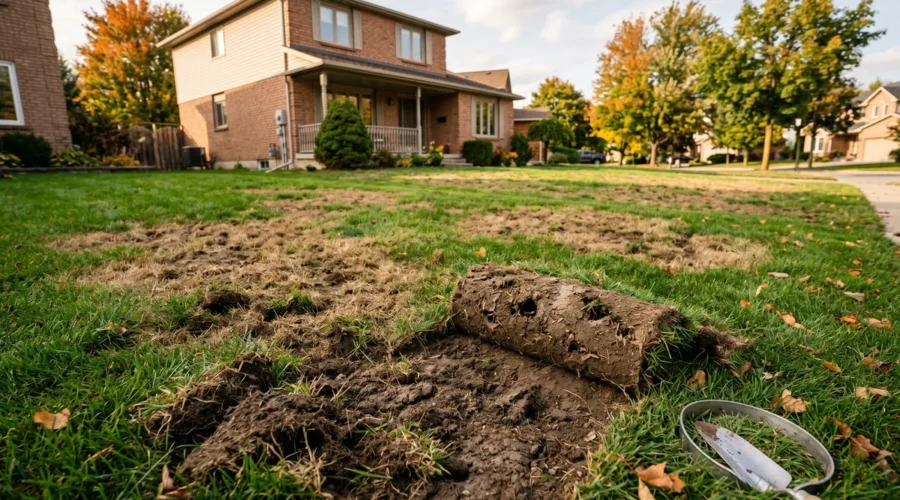
In Ontario lawns, grub damage is the single most common cause of sudden brown patches that appear in late summer after the first dry spell of August. White grubs (larvae of European chafer, Japanese beetle, and June beetle) feed on grass roots underground, which means the turf pulls up like a loose carpet long before most homeowners notice the discoloration on top. This guide covers identification, the treatment options that actually work in Ontario, and when the damage is severe enough that you need professional sod replacement to repair the lawn.
We will cover the confirmation test (the only way to be sure it is grubs and not fungus), the Ontario-legal treatment options, the exact timing window for nematodes, and repair sequencing from overseeding to full sod.
Early Signs of Grubs in a Lawn
Three symptoms together confirm a grub problem before you dig anywhere:
- Brown patches that appear after a dry spell and do not green up with watering. Healthy turf under water stress goes brown too, but recovers within a week of watering. Grub-damaged turf does not.
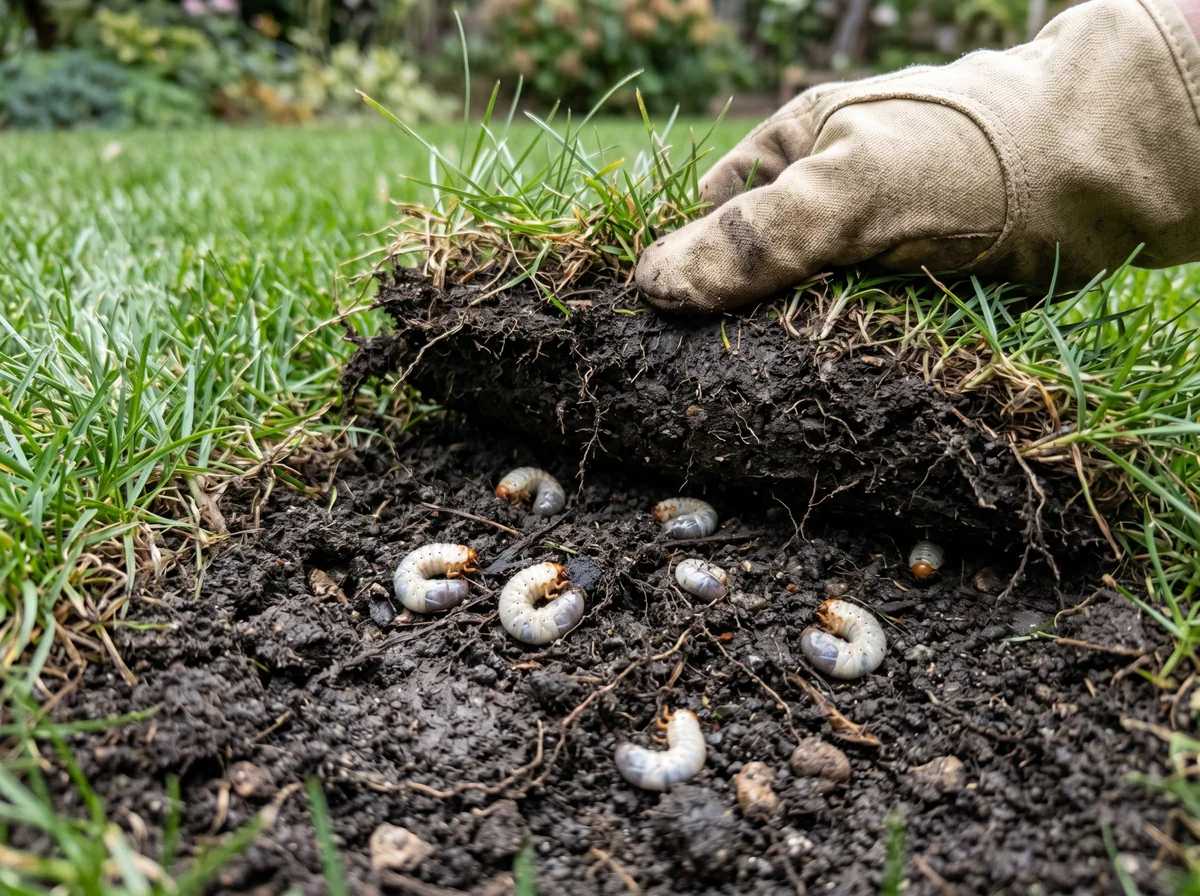
- Turf that lifts like a loose rug with almost no root attachment. Grubs have eaten the roots. Pull up a corner at the edge of a brown patch. If the blades come up but the soil underneath stays put, grubs are the cause.
- Torn-up lawn from skunks, raccoons, or birds at night. Wildlife knows grubs are a protein-rich meal. When you wake up to chunks of sod flipped over, the animals have already confirmed the diagnosis for you.
Single symptoms are ambiguous. All three together are diagnostic. Partial symptoms need the confirmation test below.
The Confirmation Test: Count Grubs Per Square Foot
The only way to be sure is to dig. Cut a 1-foot square out of a brown patch (use a spade to slice 3 sides, then roll it back on the fourth). Look in the top 2 inches of soil. Count the white C-shaped larvae you see.
- 0 to 2 grubs per square foot: Normal background population. Healthy turf tolerates this. No treatment needed.
- 3 to 5 grubs per square foot: Marginal. Monitor. If damage is already visible, treat. If not, watch the lawn and recount in 2 weeks.
- 6 to 10 grubs per square foot: Treatment threshold. Damage is active and will spread without action.
- 10+ grubs per square foot: Severe infestation. Treat immediately and plan for sod repair in patches.
The Ontario Ministry of Agriculture publishes detailed guidance on white grub biology and integrated pest management in residential and agricultural contexts. The OMAFRA white grub management fact sheet is the authoritative Ontario reference.
Treatments That are Legal in Ontario in 2026
Ontario’s Cosmetic Pesticides Ban removed most chemical grub controls from residential use. The options available to homeowners in 2026 are biological or mechanical:
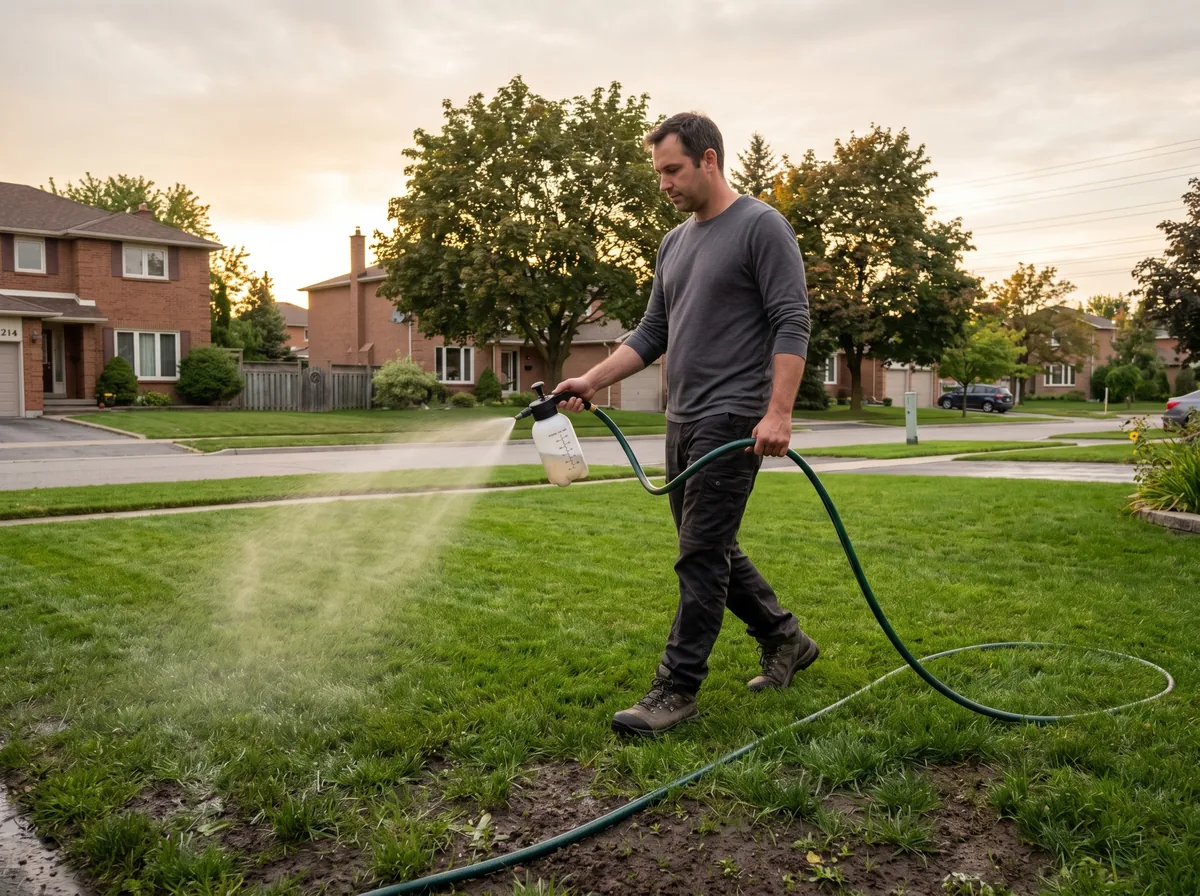
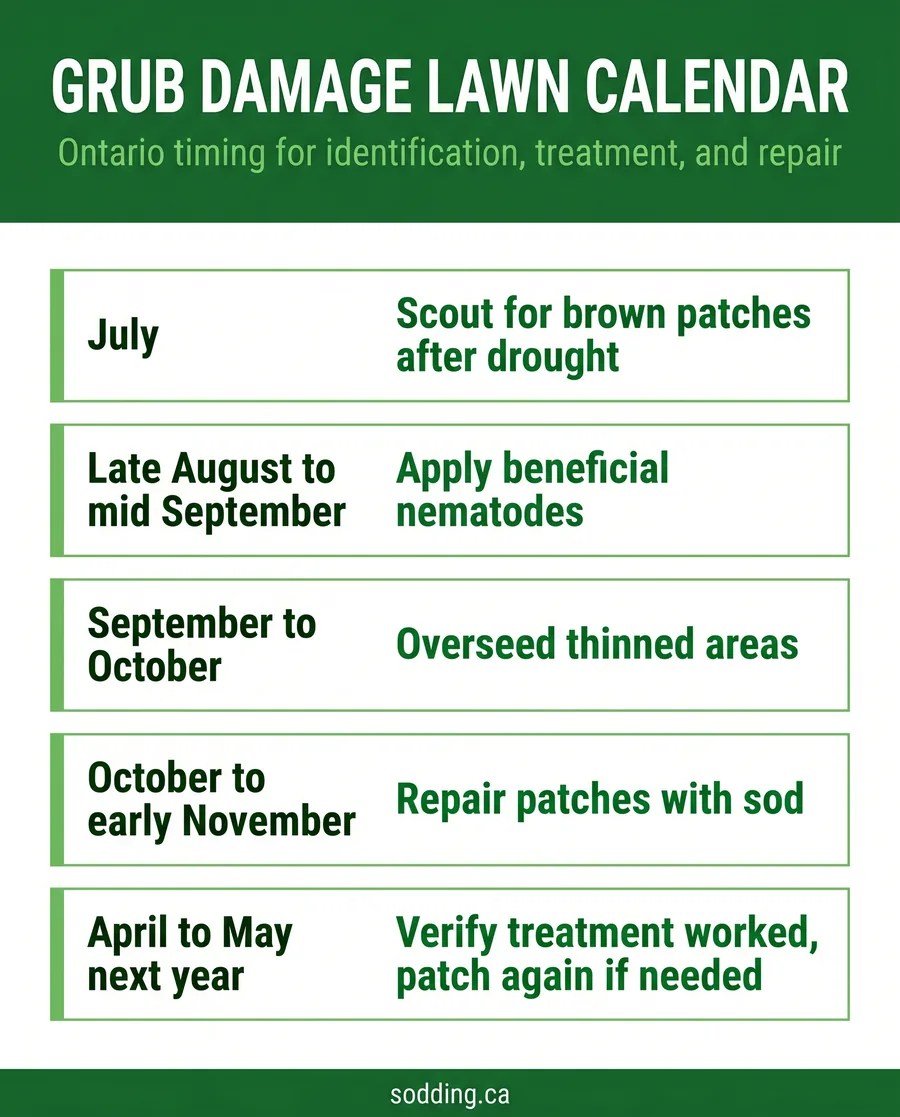
- Beneficial nematodes (Heterorhabditis bacteriophora or Steinernema). The most effective residential option. Microscopic organisms that infect and kill grubs. Applied in late August to mid-September as a liquid spray. Widely available from Ontario garden centres.
- Milky spore disease. Works against Japanese beetle grubs but not against European chafer (the dominant grub species in the GTA). Limited usefulness in southern Ontario.
- Raking, hand removal, and cultural practices. Regular aeration, taller mowing, and deep watering all reduce grub pressure by strengthening turf roots. Not a cure but a real supplement.
- Licensed applicator-only chemical options. Some synthetic insecticides (imidacloprid, chlorantraniliprole) remain available to licensed lawn care companies under specific conditions, but are not legal for homeowner direct application in Ontario.
Across Canada, provincial rules vary. Alberta and Saskatchewan allow some synthetic residential grub controls that Ontario does not.
Nematode Timing: The 4-week Window That Matters
Nematodes are effective, but only if applied in the right window. Too early (when grubs are still eggs or first-instar larvae), and nematodes cannot find a host. Too late (when grubs have burrowed deep for winter), and the nematodes cannot reach them.
The correct window in Ontario is late August to mid-September, with the sweet spot being the last week of August and the first two weeks of September. Soil temperature should still be above 12 degrees Celsius. Apply in the evening, in cloudy weather if possible, to prevent UV damage. Water the lawn before application to carry nematodes into the soil, and water again lightly afterward.
A second application, 10 to 14 days after the first, improves control dramatically. Most homeowners buy one dose and skip the second, which is why single-application nematode campaigns often underwhelm.
Repairing Grub-Damaged Lawn Areas
Once grubs are controlled, damaged areas need repair. Three paths depending on severity:
- Patches smaller than 1 square foot and shallow. Rake out the dead material, loosen the top 1 inch of soil, overseed with Kentucky bluegrass mix, topdress with quarter-inch of soil, water daily until germination. Fills in over 3 to 6 weeks.
- Patches 1 to 10 square feet or deep damage. Cut out the dead area cleanly, place new sod pieces, firm in with boots or a roller, water on new-sod schedule (twice daily for 14 days).
- More than 30 percent of the lawn damaged. Full sod replacement is faster and more reliable than patching the whole surface. Mid-August to September is the right window, right after nematode application.
New sod laid onto previously grub-infested soil needs the nematode treatment to have worked. Laying sod on soil that still has live grubs means the new lawn will suffer the same fate within a season.
Preventing Grub Problems Next Year
Grubs thrive in thin, stressed lawns. Thick, deeply rooted turf resists grub damage even at populations that would destroy a weaker lawn. The three prevention habits that matter most:
- Mow at 2.5 to 3 inches, not shorter. Taller mowing deepens roots and shades the soil. Grub egg survival drops in cooler, shaded soil.
- Deep, infrequent watering. A single 1-inch watering per week pushes roots deep. Shallow daily watering keeps roots at the surface, where grubs feed.
- Annual aeration in fall. Breaks up compaction, improves root depth, and disrupts grub habitat.
When to Stop DIYing and Call a Pro
Three situations call for professional help:
- Grub counts over 15 per square foot across a majority of the lawn. At that density, licensed applicator treatment (with synthetic insecticides unavailable to homeowners) may be needed alongside nematodes.
- Damage covers more than 40 percent of the lawn area. Full replacement is almost always faster and cheaper than partial patching at that scale.
- Repeat grub damage year after year despite nematode treatment. Something structural is wrong (soil, drainage, thatch, or timing) and a professional assessment identifies the underlying cause.
If grub damage has affected more than a quarter of your lawn, a full sod replacement this fall (after nematode treatment) is usually faster, cheaper, and healthier in the long term than patching indefinitely. Sodding Canada installs fresh bluegrass sod across the GTA, with a rooting warranty on every job. Use our booking form for a free site visit.
Grub damage Ontario identification + treatment calendar – free PDF download
A printable 10-step response plan from first symptom to full repair, on the Ontario calendar.
Download the free guideFrequently asked questions
How can I tell if my lawn damage is grubs or something else?
Three signs together confirm grubs: brown patches that do not green up with watering, turf that lifts like a loose rug with no root attachment, and wildlife (skunks, raccoons, birds) tearing up the lawn at night looking for protein. Single symptoms are ambiguous and need the confirmation test: cut a 1-foot square, roll it back, and count white C-shaped larvae in the top 2 inches of soil.
When should I apply nematodes for grubs in Ontario?
Late August to mid-September is the correct window, with the sweet spot being the last week of August and the first two weeks of September. Soil temperature should be above 12 degrees Celsius. Apply in the evening, in cloudy weather if possible, and water the lawn before and after application. A second dose 10 to 14 days later dramatically improves control.
Are nematodes actually effective against grubs?
Yes, when applied correctly. Heterorhabditis bacteriophora and Steinernema species are the two main commercial nematodes sold in Ontario, and both kill European chafer and Japanese beetle grubs at rates of 70 to 90 percent when applied in the correct window with a follow-up second dose. Single applications applied outside the window drop effectiveness to 30 to 40 percent, which is why homeowners sometimes dismiss nematodes as a placebo.
Can I sod over grub damage right away?
Only after treating the grubs. Laying fresh sod on soil that still has live grub populations means the new lawn suffers the same fate within a season. The right sequence is: confirm grubs, apply nematodes twice, wait 2 weeks, then relay damaged sections. For large damage areas, time the sod replacement for September to October right after the grub treatment.
What is the best long-term prevention against grubs?
Thick, deeply rooted turf. Mow at 2.5 to 3 inches (not shorter), water deeply once a week rather than shallow daily watering, and aerate annually in fall. Lawns with dense turf and deep roots resist grub damage even at populations that would destroy thinner lawns. This is a cumulative effect: each year of better lawn care makes the lawn more resistant.
Keep reading
Thinking about replacing the lawn instead? Where grubs have taken out more than about a third of the lawn, patch repairs stop keeping up and a full replacement is the cleaner fix. Our sod installation service covers removal, grading and fresh sod, and the ranges are on the sodding cost page. We do this across sod installation in Mississauga every season.