Listen to this article as a podcast
Listen to this article about new sod week by week: first 30 days care guide as a podcast.
New sod care in the first 30 days is mostly about water. Not complicated water schedules, not special fertilizers, just keeping the sod moist every single day until the roots knit into the soil beneath. Most homeowners who lose their new sod don't lose it to disease or poor grass quality. They lose it because they didn't water enough in the first two weeks. If you just had a professional sod installation, this guide will walk you through exactly what to do and when.
The first 30 days of new sod care in Ontario break down into four phases: installation day, week one, week two, and weeks three and four. Each phase has different rules. By day 30, you should have a lawn that's fully rooted, mowed twice, and ready for normal care.
Day 1: What to do right after installation
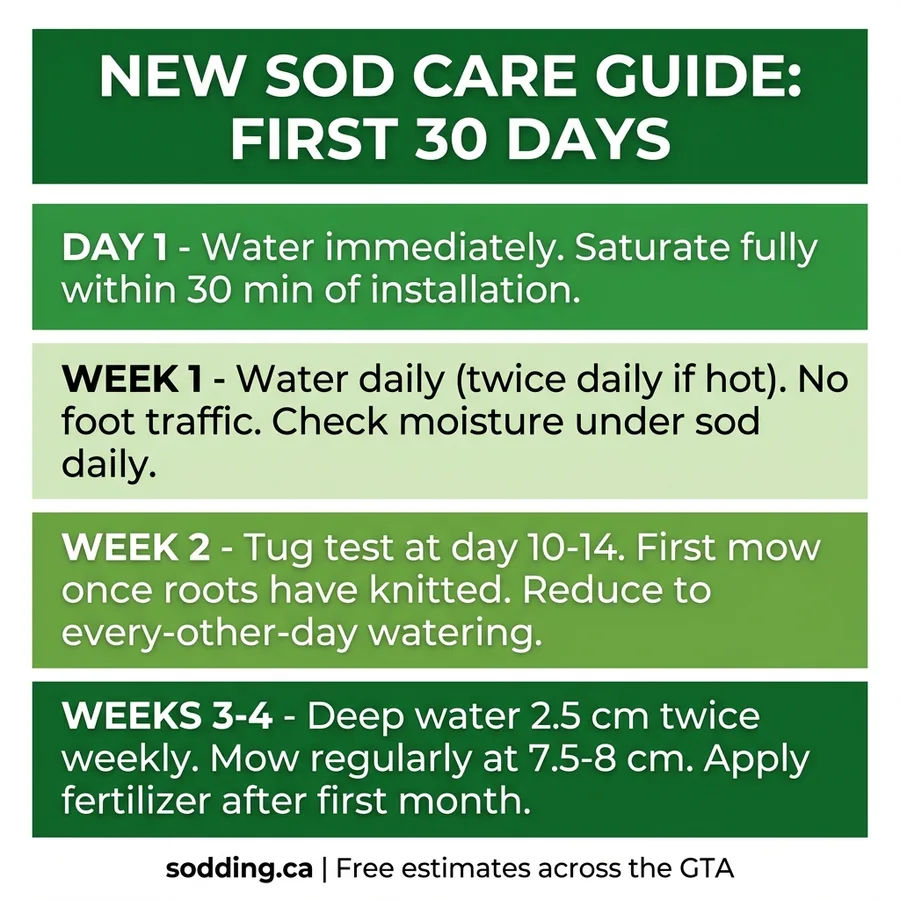
Start watering within 30 minutes of the last roll going down. Don't wait until the end of the day. Sod begins to dry out from the moment it's cut, and it's been in a roll since early morning. The moment it's laid flat, it's already thirsty.
Run each zone of your irrigation system, or walk your hose slowly across the entire lawn, until the sod is completely saturated and water is beginning to pool slightly at the seams. Then stop. You want moist, not flooded.
People often ask: how do I know if my new sod has enough water?
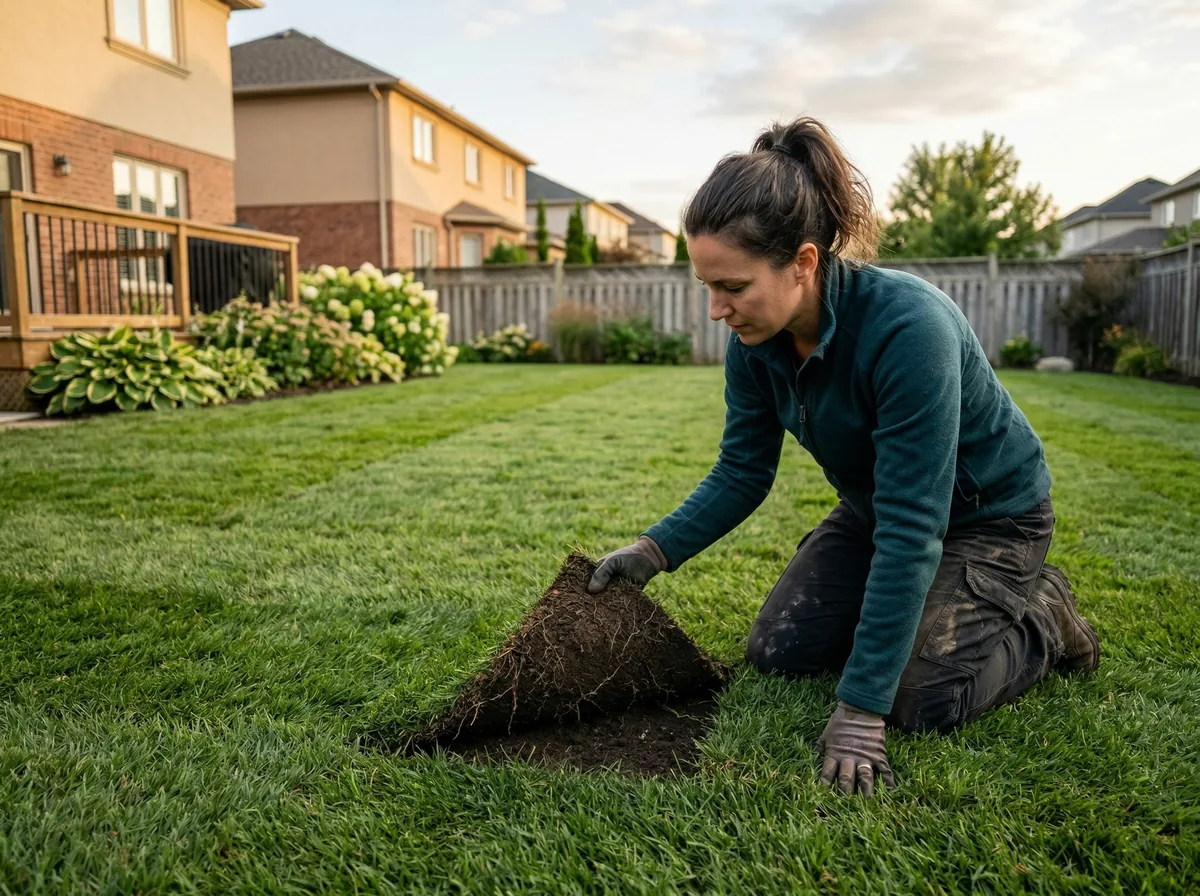
Lift a corner of the sod and check the soil below. The top 2 to 3 cm of soil beneath the sod should be visibly moist. Not muddy, not dry. If the soil beneath is dry while the sod surface looks green, you're not watering long enough per session. The water needs to penetrate through the sod layer and into the ground below for roots to grow downward.
Week 1: Critical rooting phase
This is the most important week. The sod has no roots into your soil yet. It's essentially sitting on the surface, surviving entirely on stored moisture in the grass and the thin layer of growing medium attached to the roots. Your job this week is to never let it dry out.
Watering frequency: Once in the morning, every day. If temperatures are above 25 degrees Celsius, add a second session in the early afternoon. Never water in the evening, it promotes fungal disease.
Duration: Long enough to keep the soil beneath moist. For most GTA lawns, this is 20 to 30 minutes per zone with a standard rotary sprinkler, or 15 to 20 minutes with an oscillating sprinkler. The exact time depends on your water pressure and sprinkler type. Lift a corner and check after the first session to calibrate.
Foot traffic: Keep people and pets off the sod entirely this week. Every footstep compresses the sod into the soil and breaks the fragile root tips trying to establish. Even one shortcut across the lawn can leave a visible path for weeks.
Did you know?
New sod in Ontario begins sending roots into the soil within 3 to 5 days of installation in warm conditions. You won't see this from the surface, but a gentle tug on a sod seam after 5 days will feel slightly more resistance than on day one. By day 10, in good conditions, you should feel real resistance when you try to lift a piece.
Week 2: First tug test and first mow
By day 10 to 14, it's time for the tug test. Grab a corner of the sod, roughly at a seam, and pull firmly. If it lifts easily, rooting is still in progress. Keep watering daily and test again in 3 to 4 days. If it resists, the roots have knitted in and you can begin reducing watering frequency.
Reducing watering once roots knit
Once the tug test passes, drop from daily watering to every other day. Give the soil time to dry slightly between sessions. This encourages roots to grow deeper in search of moisture, which is exactly what you want for a resilient lawn going into summer.
The first mow
Mow for the first time once the sod passes the tug test. Mow at 7.5 to 8 cm, the same as a normal Ontario lawn. Do not scalp the new lawn on the first cut. Make sure your mower blade is sharp. A dull blade tears grass instead of cutting it cleanly, and torn grass is more vulnerable to disease in a lawn that's still establishing.
Leave the clippings on the lawn for the first mow. They decompose quickly and return small amounts of nitrogen to the soil.
"I made the mistake of letting people walk on the new sod after 3 days because it looked fine. Those walking paths were visible for two months. Next time I'm putting up tape and being strict about it for at least 2 weeks."
r/lawncare homeowner, Ontario, 2024

Weeks 3 and 4: Normal routine begins
By week three, most Ontario lawns installed in spring or fall are fully established. The roots extend several centimetres into the soil, the sod won't lift without tools, and the grass is growing visibly. From here, you transition to normal care.
Watering: Move to deep, infrequent watering, about 2.5 cm once or twice per week depending on rainfall and temperature. The goal now is to encourage deep roots, not constant surface moisture.
Mowing: Mow on a regular schedule, every 5 to 7 days when the lawn is actively growing. Continue at 7.5 to 8 cm. Don't remove more than one-third of the blade in a single cut.
Fertilizer: If your installer applied starter fertilizer before installation, hold off on additional fertilizer until after the first month. Then apply a balanced slow-release fertilizer. The lawn doesn't need to be pushed hard in its first season.
Watering schedule tool for new sod
New sod watering guide
Common first-month problems and how to fix them
Brown edges or seam gaps: The sod is drying out. Increase watering frequency immediately and hand-water the affected edges until they recover. Seam gaps don't close on their own, but they fill in as roots spread sideways over the following weeks.
Yellow or pale sod: Two possible causes. If it yellows within the first week, it may have been stressed before delivery. Water more and give it 10 days. If yellowing starts at week two or three, it may need fertilizer, though wait until after the first mow before applying anything.
Visible footpaths or tire tracks: These resolve on their own as the sod roots and fills in. The grass will grow up and out over the compressed areas. Don't add extra sand or soil on top.
For post-installation support, Sodding Canada serves Vaughan, Toronto, and Richmond Hill among many GTA communities. Book a follow-up assessment if you're seeing problems after the first two weeks.
Download the free quick guide
Save this guide as a PDF and keep it handy for your next lawn project.
New Sod Week by Week: First 30 Days Care Guide — Free PDF GuideFrequently asked questions
When can I walk on new sod?
The general rule is to stay off new sod for the first two weeks as much as possible. After two weeks, do the tug test: grab a corner of the sod and pull firmly. If it resists and doesn't lift, the roots have knitted and light foot traffic is fine. Full traffic, kids running and playing, typically takes 4 to 6 weeks.
How often should I water new sod in the first week?
Daily, or twice daily if it is hot. The goal is to keep the sod moist all the way through and into the top centimetre of soil beneath. Early morning watering is best. Check under a corner of the sod daily to confirm the soil beneath is staying moist.
What happens if I don't water new sod enough in Ontario?
New sod that dries out in the first two weeks will begin to shrink, the seams between rolls will open up, and the edges will curl. If it dries completely before rooting, the sod will die and need to be replaced. This is the most common reason sod fails in Ontario.
Should I fertilize new sod right away?
No. If your installer applied a starter fertilizer before laying the sod, that is sufficient for the first 4 to 6 weeks. Adding more fertilizer too early can stress new sod. Wait until after the first mow, roughly 2 to 3 weeks in, before applying any additional fertilizer.
Can new sod survive Ontario frost?
Established sod, rooted in for 3 or more weeks, handles light Ontario frosts without permanent damage. Fresh sod in the first week is more vulnerable. If a hard frost below -4 degrees Celsius is forecast within the first 5 days, a light frost cloth overnight can help. Most spring and fall installations in the GTA don't require this.
Sodding Canada handles post-installation care consultations for all our installations across the GTA. If you’re having questions about your new lawn in Markham, North York, or anywhere else we serve, get in touch and we’ll walk you through it.