Listen to this article as a podcast
Listen to this article about spring lawn prep checklist for ontario homeowners as a podcast.
A solid spring lawn prep routine in Ontario takes about a half day of work spread over two or three weeks. The payoff is a lawn that's thick, green, and weed-resistant by June, instead of the patchy, thin result that comes from skipping steps or starting too early. Whether you're maintaining an existing lawn or assessing whether it's time for a full lawn replacement, this checklist will tell you exactly what to do and when.
Spring lawn prep Ontario homeowners should know has one non-negotiable rule: wait for the soil to dry before you start. Working on soft, wet spring soil compacts it and damages grass crowns at exactly the moment the lawn is waking up. Patience in April saves work in June.
When to start spring lawn prep in the GTA
The right time to begin is when all of these are true: daytime temperatures are consistently above 10 degrees Celsius, no frost is forecast for the next week, and the soil no longer leaves footprints under normal walking weight. In most GTA locations, including Vaughan, Mississauga, and North York, this falls between April 25 and May 10 in most years.
People often ask: when should I start spring lawn prep in Ontario?
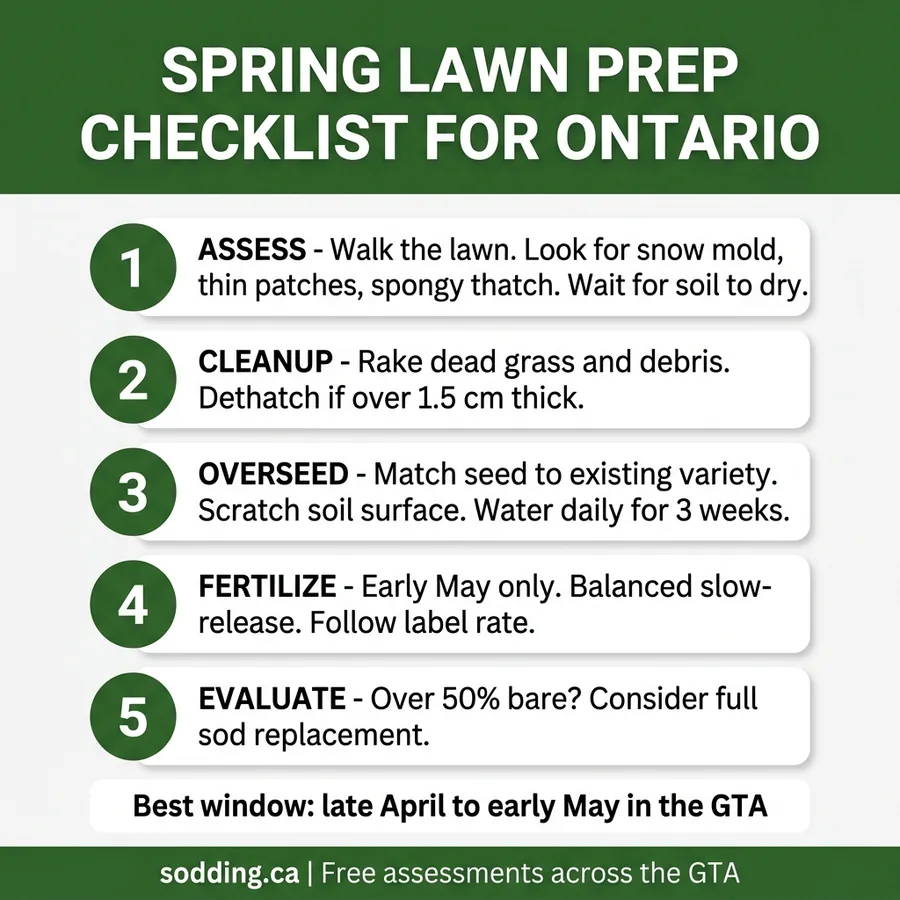
The GTA standard is late April to early May. Before that, even if it looks warm, the soil is often still saturated from snowmelt and freeze-thaw. Walk across your lawn. If you can see your footprints in the turf for more than a few seconds, the ground is too wet to work on. Come back in a week.
Step 1: Assess the lawn before doing anything
Walk the entire lawn slowly and look for: areas of snow mold (white or grey matted patches), thin or bare areas from last summer's drought or foot traffic, obvious thatch buildup (the lawn feels spongy underfoot), and any low spots or areas with poor drainage.
Write down what you find. Assessing first means you don't waste time dethatching an area that actually needs overseeding, or fertilizing a section that needs complete replacement.
Did you know?
Snow mold appears as white, grey, or pink circular patches in spring and is caused by fungal growth under snow cover. It looks alarming but is rarely fatal. Gently rake the matted grass to break up the mold and improve air circulation. Most snow mold patches recover fully by late May once the lawn dries out and begins growing.
Step 2: Spring cleanup and dethatching
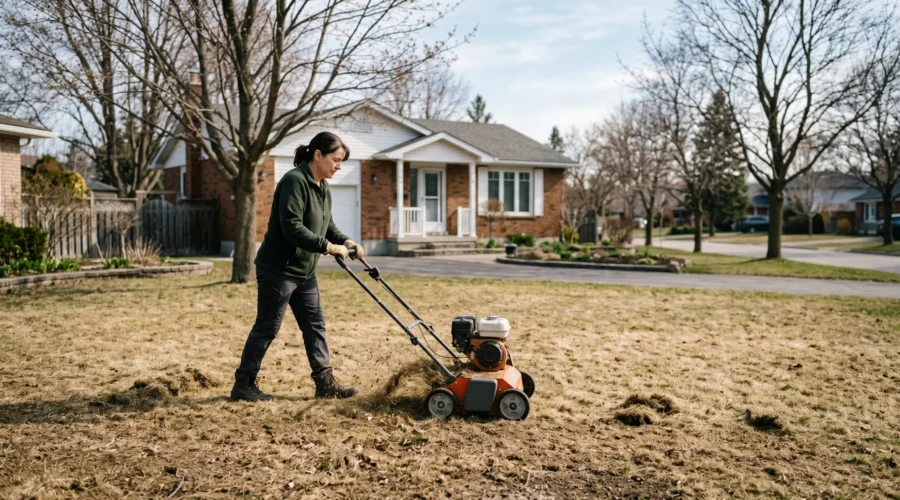
Start with a thorough rake to remove dead grass, matted leaves, and debris. Bag everything rather than leaving it on the lawn, since it can harbour mold and prevent light from reaching the grass crowns below.
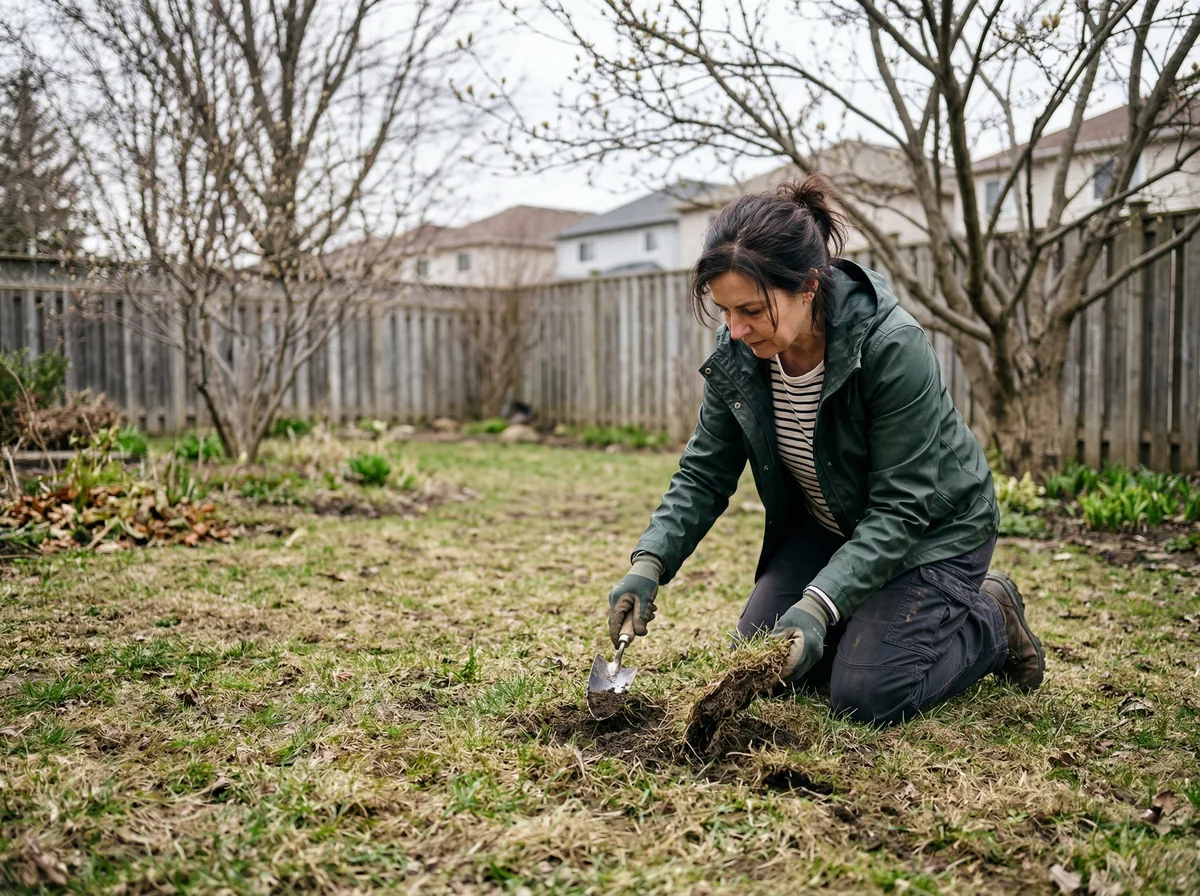
Check the thatch layer by cutting a small plug of turf with a shovel. The brown spongy layer between the green grass and the soil surface is thatch. Under 1 cm is fine. Between 1 and 1.5 cm, a light dethatch with a rake is appropriate. Over 1.5 cm, use a power dethatcher.
Pro tip
Don't do heavy core aeration in spring in Ontario. Ontario clay soils are still cold and slow to recover from aeration holes in April and early May. Save core aeration for early September when the lawn is actively growing and plugs break down quickly. A light spring dethatch followed by fall core aeration is the correct sequence for GTA lawns.
Step 3: Overseed thin and bare patches
Spring is a decent time to overseed thin areas, though fall is better. If you have bare patches larger than a dinner plate, overseeding them in spring gives them a full growing season to establish before next winter.
Use a grass seed that matches your existing lawn variety. If your lawn is Kentucky bluegrass, use a KBG blend. If it's mixed fescue, use a fescue blend. Seeding a different variety into an existing lawn will produce visible clumping and a non-uniform look.
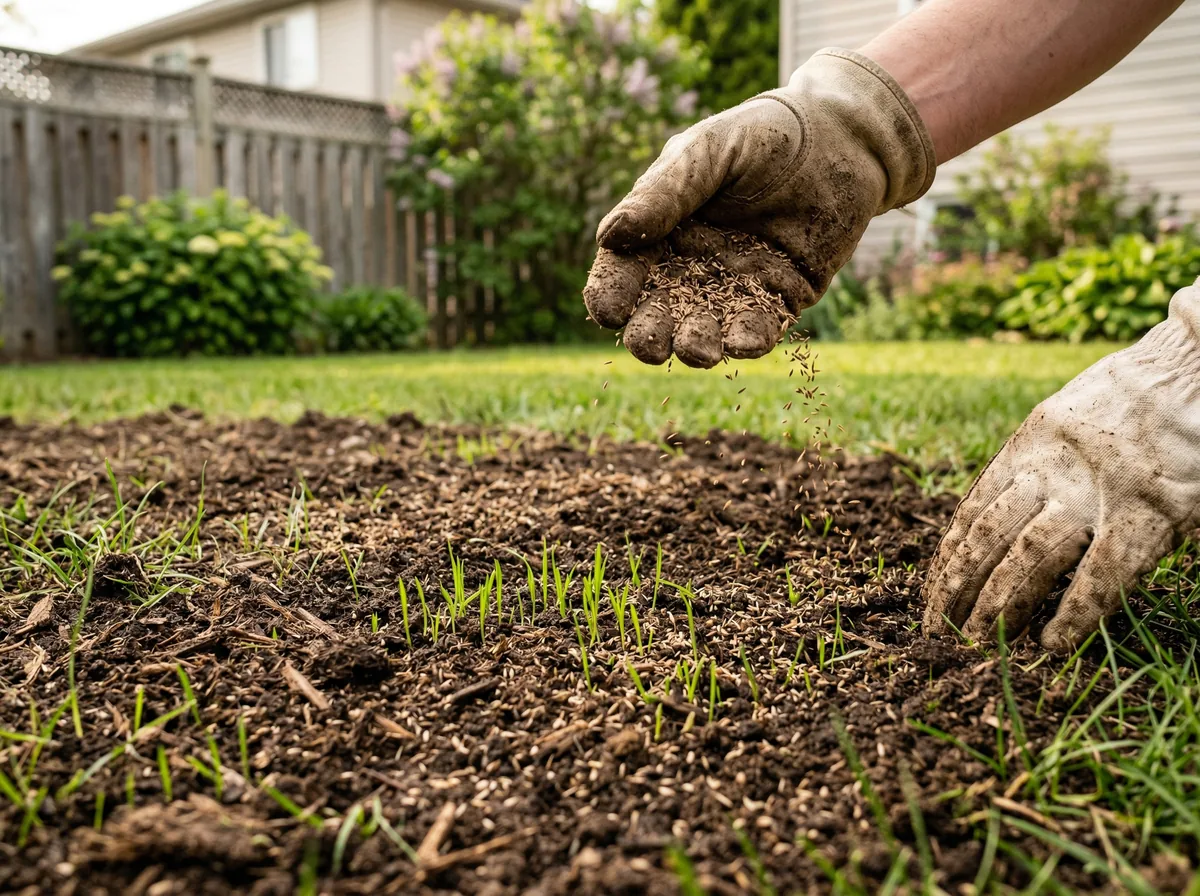
Overseed onto lightly scratched soil for good seed-to-soil contact. Keep the area consistently moist for 3 weeks. New grass seed in Ontario typically germinates in 10 to 21 days depending on soil temperature and variety.
"Every spring I'd overseed the bare spots, wait 3 weeks, and see nothing happen. Finally realized I was applying fertilizer right away and cooking the new seedlings. Now I wait until the new grass is 5 cm tall before feeding and the results are completely different."
r/lawncare Ontario homeowner, 2024
Step 4: First fertilizer of the season
Early May is the right time for the first lawn fertilizer in Ontario. Not April, not immediately after the snow melts. The grass needs to be actively growing before it can use the nitrogen you're applying. Fertilizing too early pushes a flush of top growth before the roots are ready, leaving the lawn more vulnerable to summer stress.
Use a balanced slow-release fertilizer. The Ontario Ministry of Agriculture's lawn care guidelines recommend low-nitrogen applications with a significant portion from slow-release sources to reduce runoff risk. A product labelled 20-5-10 or similar, with at least 50 percent of nitrogen from slow-release sources, is appropriate.
Apply according to the product's label rate. More is not better. Over-fertilizing in spring is a common mistake in Ontario that produces lush, soft growth that is more susceptible to disease and drought stress later in the summer.
Step 5: When the lawn needs more than prep
Sometimes you walk the lawn in spring and realize it's past the point of renovation. More than 50 percent of the lawn is bare or dead, persistent grassy weeds like quackgrass have taken over, or the soil underneath has significant drainage or grade problems. When any of those are true, full lawn replacement with fresh sod is more cost-effective than trying to patch and overseed.
Sodding Canada installs new lawns across Toronto and the GTA from late April through June and again in August and September. If you're not sure whether your lawn can be saved or needs replacing, book a free assessment and we'll give you an honest answer.
Download the free quick guide
Save this guide as a PDF and keep it handy for your next lawn project.
Spring Lawn Prep Checklist for Ontario Homeowners — Free PDF GuideFrequently asked questions
When should I start spring lawn prep in Ontario?
Most years, the right time to begin spring lawn prep in the GTA is when daytime temperatures are consistently above 10 degrees Celsius and the soil has dried out enough that you don't leave footprints when you walk across it. In the GTA, this typically falls between late April and early May. Starting too early on wet, soft soil causes more damage than it prevents.
Should I dethatch or aerate my Ontario lawn in spring?
Dethatching in spring is appropriate if your thatch layer is over 1.5 cm thick and the lawn looks matted or spongy. Light dethatching is fine in spring. Heavy core aeration is better saved for early September when Ontario turf is actively growing and can recover quickly. A light spring dethatch followed by full core aeration in fall is the standard Ontario approach.
When should I apply the first fertilizer of the year?
Early May is the right timing for the first lawn fertilizer application in Ontario. Applying before the soil is warm and the grass is actively growing pushes top growth before roots are ready to support it. A balanced slow-release fertilizer in early May gives the grass a steady supply of nutrients through the critical spring green-up period.
Why does my lawn look thin or patchy in spring?
Thin or patchy spring lawns in Ontario are usually caused by one of four things: snow mold from winter, heavy foot traffic compacting the soil near pathways, drought stress the previous summer, or thin turf that needed overseeding last fall and never got it. Most cases respond well to dethatching, overseeding, and consistent spring watering.
Can I overseed and fertilize at the same time in spring?
Yes, but use a starter fertilizer rather than a regular lawn fertilizer when overseeding. Starter fertilizers have a higher phosphorus content that supports seed germination and early root development. Apply after light dethatching and overseeding, then water consistently for the first 3 weeks.
Sodding Canada serves homeowners across the GTA every spring, from lawn assessments to full installations. If your spring prep reveals that your lawn needs more than a cleanup in Richmond Hill, Vaughan, or anywhere else we work, book a free assessment and we’ll take a look.