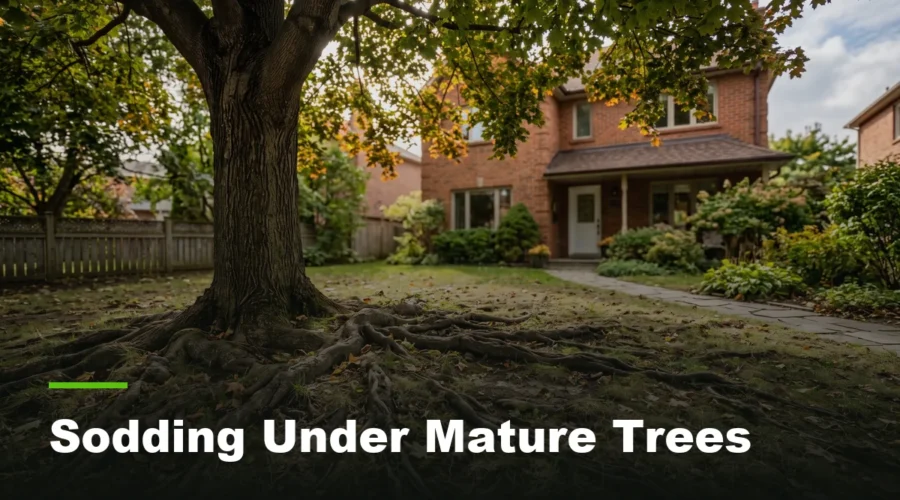
Can you actually lay sod under mature trees and expect it to live? Sometimes, and the answer depends far more on the roots than on the shade. Most failed attempts in older Etobicoke neighbourhoods come from treating a big maple as a lighting problem when it is really a competition problem, and from a lawn installation in Etobicoke booked before anyone looked down at what is under the grass.
Work through the steps below in order. The first three decide whether the rest are worth doing at all.
Why Sod Struggles Under Mature Trees
Three forces work against sod under mature trees, and shade is only one of them.
Root Competition, the One People Underestimate
A mature tree’s feeder roots sit in the top layer of soil, exactly where grass roots want to be. They are bigger, established, and far better at taking up water. Grass planted there is competing with something that was there first and is winning easily.
The Rain Shadow
A dense canopy intercepts light rain before it reaches the ground. The soil under a big tree is frequently drier than the open lawn ten metres away, even though it looks cooler and damper.
Light, and How Little There Is
Grass under heavy shade produces fewer, finer, weaker blades. That is also why a thin shaded lawn picks up weeds so readily. Sod under mature trees is not doomed by shade alone, but shade sets the ceiling on how good it can get.
Red Flag
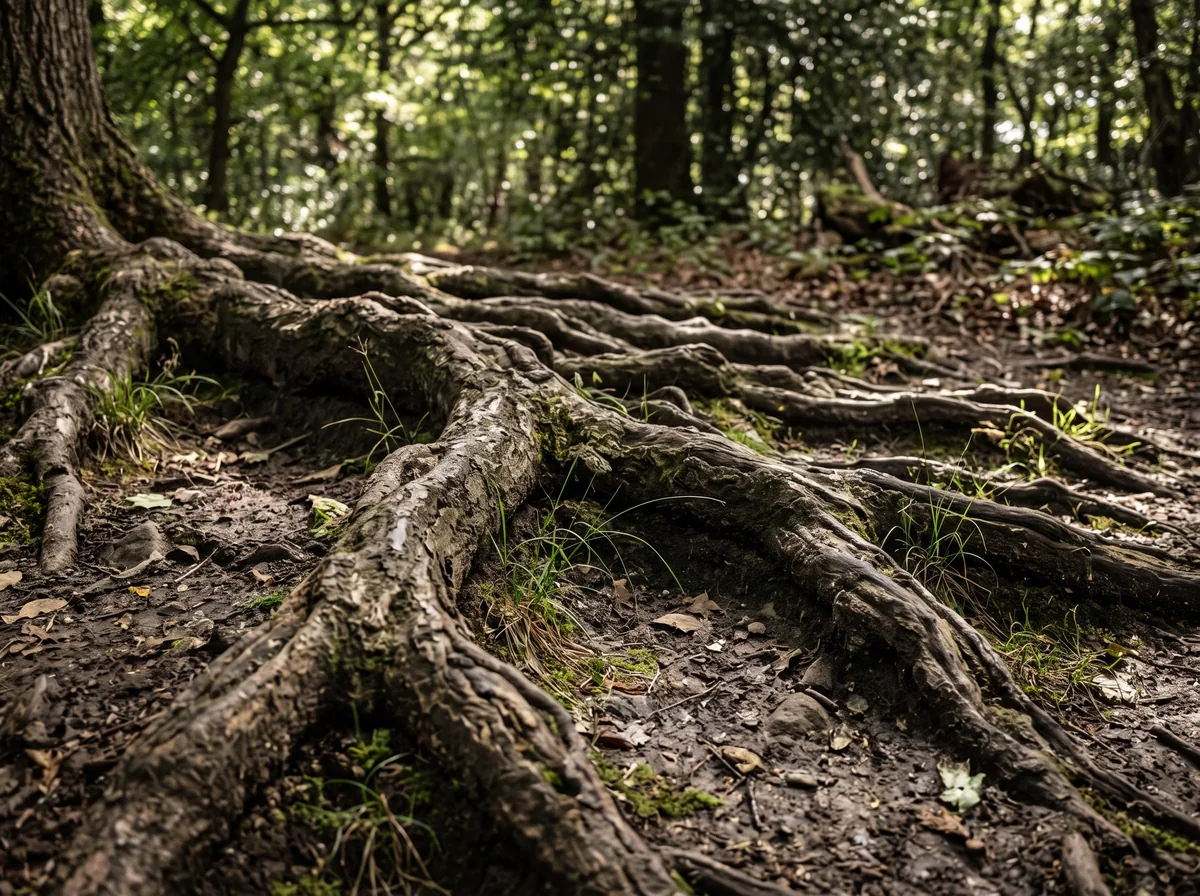
Never solve this by adding a thick layer of topsoil over the root zone. Burying the roots of a mature tree cuts off the oxygen exchange they depend on, and the damage is slow, expensive, and frequently fatal to the tree. Any plan that starts with several inches of fill over the roots is the wrong plan.
Good to Know
This article is general guidance, not an assessment of your property or your tree. Work near a mature tree can affect its health and stability, and municipal rules on tree protection and root disturbance vary and are revised over time. Check what applies to your address with your municipality, and speak to a qualified arborist before disturbing the root zone. Sodding Canada is not responsible for decisions made solely on the basis of this article.
Step 1: Work Out What You Are Actually Fighting
Before ordering anything, spend ten minutes with the site. You are looking for three things.
- Surface roots: Are large roots visible at or just under the surface? If a rake catches on them, that is your dominant constraint.
- Soil depth: Push a screwdriver into the ground in several places. If it stops after a couple of centimetres, there is not much soil to work with.
- How dark it really is: Look at the spot at mid-morning, midday, and late afternoon. Dappled light moving through the day is a different situation from constant deep shade.
Write down what you find. Those three observations decide everything that follows, and they are also what a contractor will ask you about.
Step 2: Check the Rules Before You Touch the Roots
This is the step homeowners skip, and it is the one with consequences beyond a patchy lawn.
Etobicoke falls within the City of Toronto, and the City regulates work affecting protected trees, including activity within the root zone, through its tree protection framework. The relevant starting point is the City of Toronto’s tree protection permit page. Whether your particular tree is covered depends on its size, its species, and whether it sits on private or City property, and the thresholds are set by law rather than by rule of thumb.
The practical instruction is simple. Add only a thin layer of quality soil, and before excavating within the area under the canopy, confirm with the City what applies to your address. It costs a phone call. Getting it wrong can cost considerably more.
Pro Tip
Take photographs of the root zone before anyone starts work, with something in frame for scale. If a question ever comes up about what condition the tree was in beforehand, you will be glad you have them. It takes two minutes and it has saved more than one homeowner an awkward conversation.
Step 3: Be Honest About the Light
Now match the plan to the conditions rather than to the photo you have in your head.
| What You Observed | Realistic Outcome | What to Do |
|---|---|---|
| Dappled light most of the day | A decent shade-tolerant lawn is achievable | Proceed with a shade blend |
| A few hours of direct sun, shade the rest | Thinner than open lawn but workable | Proceed, mow high, expect maintenance |
| Deep shade all day, dense evergreen canopy | Grass will thin out whatever you do | Consider planting or mulch instead |
| Heavy surface roots with almost no soil | Sod will not root properly | Mulch ring, or a bed under the canopy |
| Dry, hard, compacted ground under the tree | Poor establishment without preparation | Relieve compaction gently, then reassess |
If two of your three observations land in the bottom rows, the honest recommendation is not to buy sod for under-mature trees at all. Advice on picking a blend for shade or full sun covers the species question in more depth once you have decided grass is viable at all.
Step 4: Prepare Without Wrecking the Tree
Preparing for sod under mature trees is deliberately gentler than preparing open ground. The usual approach of stripping and rotovating is exactly what you must not do here.
- Remove the old growth by hand or with a shallow cut: Take off the existing thin grass and thatch without digging into the root plate.
- Leave large roots alone: Work around anything substantial. Sod laid over a root that sits proud of the surface will always dry out along that line, and that is a cosmetic price worth paying to keep the tree healthy.
- Relieve compaction gently: Do not cut roots, add soil, fork, excavate, or change the grade within a Tree Protection Zone until a qualified arborist has assessed the tree and the City has confirmed whether approval is required
- Rake to a fine, even surface: Contact between sod and soil is what lets it root, and that matters more here than anywhere else in the garden.
Step 5: Lay and Settle the Sod
Sod under mature trees needs a shade-tolerant blend, not whatever is on the truck. Fine fescues are the usual backbone of a shade mix in this climate because they tolerate low light better than the bluegrass that dominates a standard sun blend.
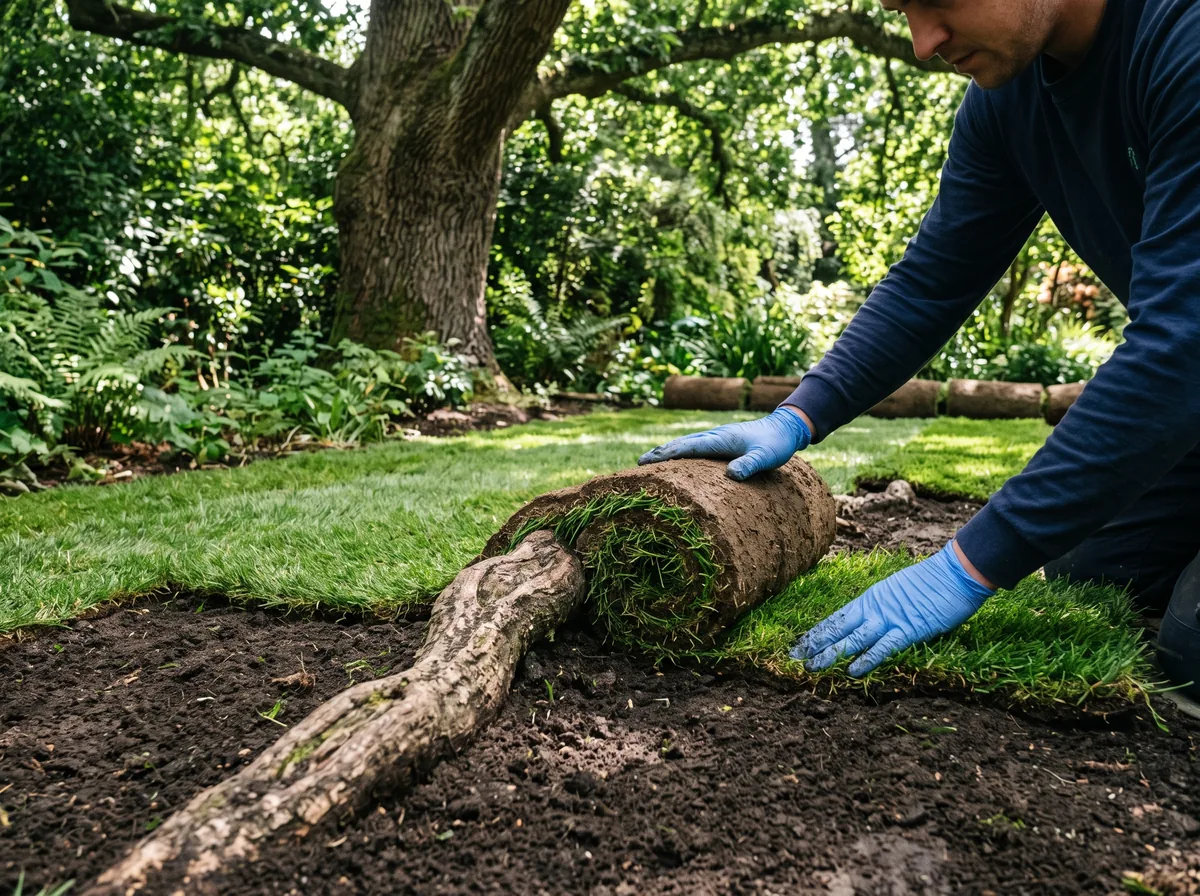
- Lay pieces so seams are tight, with no gaps for light to reach the soil.
- Stagger the joints like brickwork rather than lining them up.
- Cut around root flares neatly rather than forcing sod over them.
- Press the sod down into contact with the soil. Do not pound it with a heavy roller over the root zone.
- Water it in immediately, before the roll edges have a chance to dry.
Step 6: Water Two Things at Once
This is where sod under mature trees differs most from a normal lawn installation, and where most of them are lost.
New sod needs frequent water to root. The tree above it is drinking hard from the same soil, and the canopy is keeping ordinary rain off. So the ground under a tree needs noticeably more water than the open lawn, for longer, and you cannot judge it by looking at the surface.
Check by lifting a corner of a piece after a week. If the underside is damp and pale roots are reaching down into the soil, it is working. If the underside is dry, increase the watering rather than waiting to see what happens.
Once established, keep mowing high in that area all season. Every extra centimetre of leaf is extra surface catching what little light there is.
When to Stop Trying to Grow Grass There
Sometimes the right professional answer is that this patch is not a lawn.
If you have relaid the same area twice, if the soil is barely deep enough to cover the roots, or if the canopy is genuinely dark all day, sod under mature trees will keep failing, and you will keep paying for it. A mulch ring under the canopy with lawn beyond the drip line looks deliberate, costs less over time, and is considerably better for the tree.
Nobody enjoys being told the answer is not grass. It is still cheaper than the third attempt.
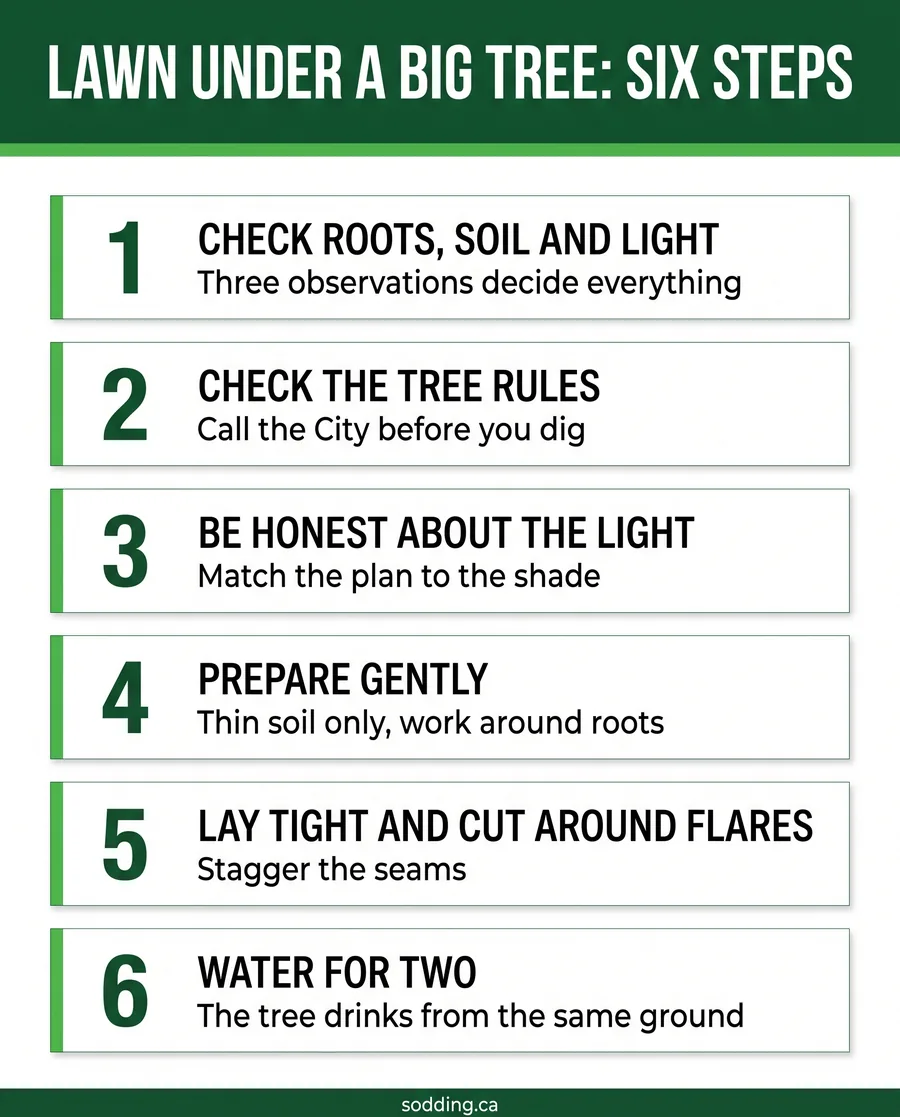
Download the Free Quick Guide
A printable version of the six steps, the three site checks that come first, and the point at which mulch beats another attempt at grass.
Frequently Asked Questions
If you are planning this for your own garden, do these three first:
- Push a screwdriver into the ground under the canopy in five places and note where it stops.
- Photograph the area at mid-morning, midday, and late afternoon.
- Call the City about your tree before anyone brings a spade.
Sodding Canada installs sod under mature trees, with shade-tolerant blends, throughout the west end of the city and across Toronto and Mississauga. If you are not sure whether your spot is worth sodding at all, book a site visit and we will tell you straight, including when the answer is mulch.