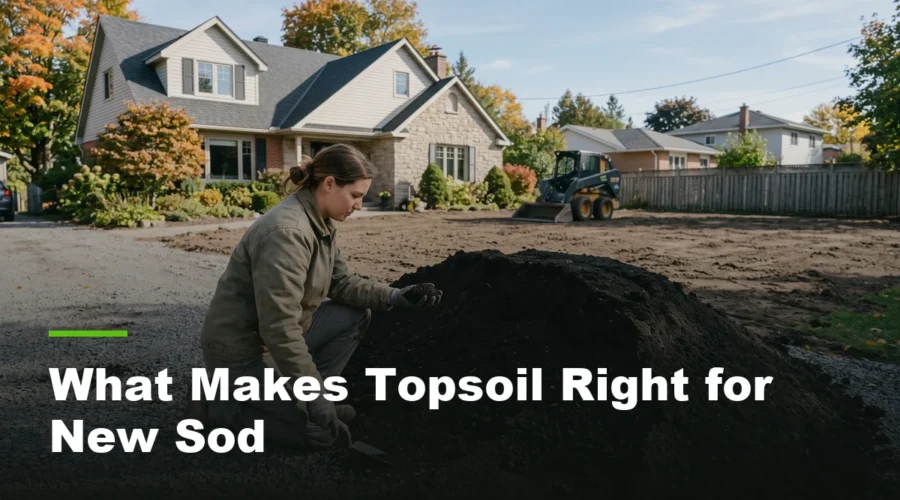
Two homeowners order the exact same sod, from the exact same farm, on the exact same week. One lawn is thick and even by its second summer. The other stays thin along one side no matter how much it gets watered. The difference almost never traces back to the grass. It traces back to the topsoil for sod installation underneath it, the part nobody sees once the rolls are down and the part most quotes barely mention. Before you book a professional sod installation, it is worth understanding what that layer of soil is actually supposed to do.
This is not about testing your soil, which is its own step covered elsewhere. This is about what good topsoil looks like once you know what you are dealing with, and how to tell a good load from a bad one before it gets spread.
What topsoil for sod installation actually does
Sod arrives with roots that are only a few centimetres deep, cut away from the bulk of the root system it had at the farm. Every one of those roots has to push down into whatever is directly beneath the roll, find something to hold onto, and start pulling up water and nutrients on its own within a matter of weeks. Quality topsoil for sod installation is what makes that possible: it holds enough moisture to keep roots from drying out, drains well enough that they do not sit waterlogged, and is loose enough for a young root to actually move through it.
Subsoil, the layer usually sitting just under a thin skim of topsoil on most residential lots, does none of that well. It is typically denser, lower in organic matter, and often compacted from construction traffic. New sod laid straight onto exposed subsoil can survive, but it tends to struggle in exactly the way that first homeowner’s lawn did: patchy, slow to fill in, and thin in whichever section had the least topsoil to begin with. Everything in the rest of this guide comes back to that one point: good topsoil for a sod installation is what closes that gap.
How deep the topsoil layer should be
There is no single number that fits every yard, since the right depth depends on what is already there, your soil type, and how much grading the site needs. As a general principle, though, a topsoil layer that is too thin gives new roots almost nowhere to go before they hit subsoil, while a layer that is inconsistent from one section of the yard to the next tends to produce exactly the patchy, uneven growth pattern that shows up a season or two later.
General turf management guidance published by the Ontario Ministry of Agriculture, Food and Agribusiness treats a workable, consistent topsoil layer as one of the basic conditions for establishing healthy turf. The right depth for your specific property is something a site visit can confirm; treat any number you see quoted online as a starting point for that conversation, not a fixed target.
Did you know
Depth alone does not fix an uneven layer. A yard with six centimetres of topsoil in one corner and barely two in another will grow unevenly even if the average depth across the whole property looks fine on paper. Consistency across the surface matters as much as the number itself.
Structure: why loam beats sand or heavy clay alone
Topsoil is not one material. It is a mix of mineral particles, organic matter, air and water, and the balance of that mix is what soil scientists call structure. A well structured loam holds together enough to retain moisture but still has enough pore space for roots and water to move through it.
- Heavy clay on its own holds water well but drains slowly and compacts easily under foot traffic or equipment, which can leave new roots sitting in saturated soil after rain.
- Pure sand on its own drains quickly, sometimes too quickly, and holds onto very little of the water or nutrients a young root needs between waterings.
- A blended loam, generally with a mix of sand, silt and clay particles plus organic matter, tends to balance drainage against water retention better than any single component on its own.
This is also where a supplier’s reputation starts to matter. Screened, blended topsoil sold specifically for turf use is a different product from generic fill dirt, even when both are labelled loosely as topsoil. Asking what the blend actually contains is a reasonable question to bring to any quote. Getting the structure right is half the work of sourcing good topsoil for a sod installation.
Organic content, and why more is not always better
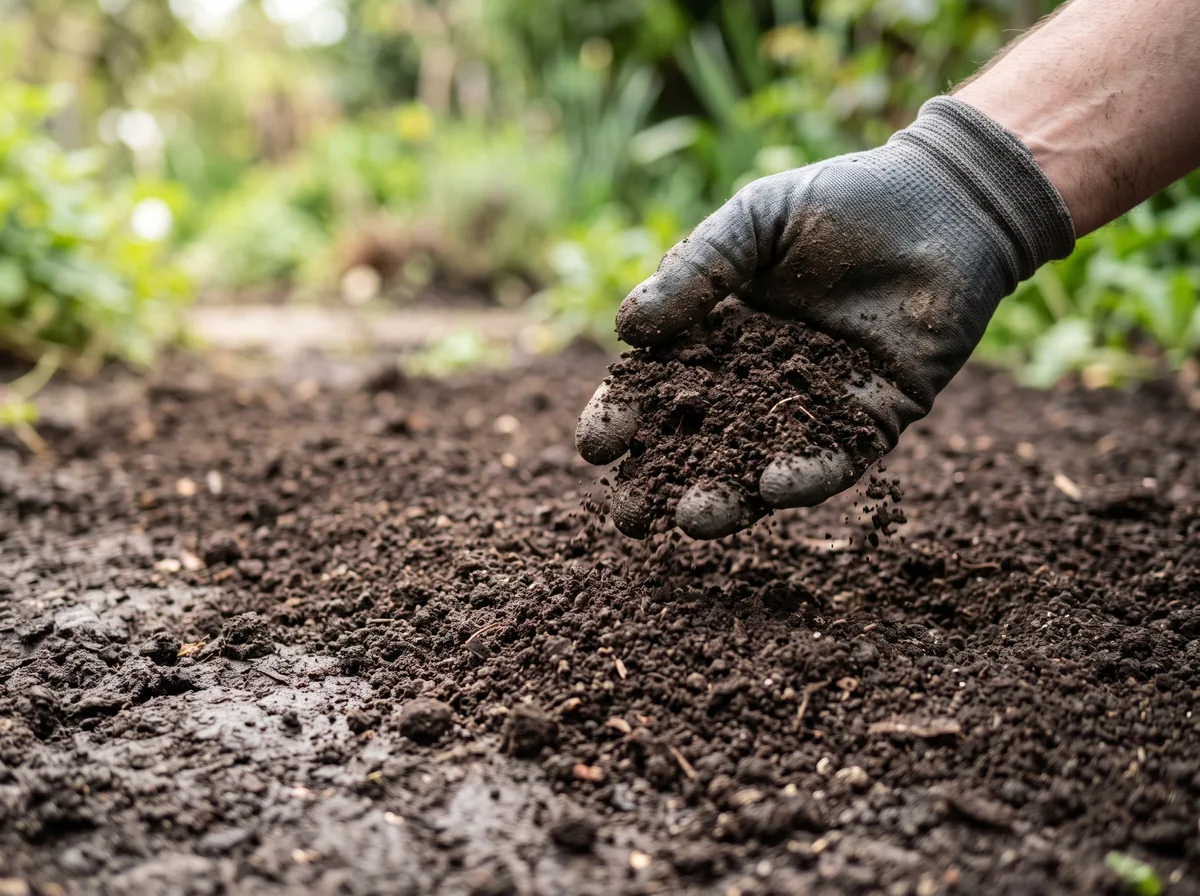
Organic matter, mainly decomposed plant material, is what gives good topsoil its dark colour and its ability to hold both water and nutrients. A reasonable amount of organic content generally supports steadier root growth than a mineral soil with almost none. That said, more is not automatically better.
Topsoil that is mostly undecomposed organic material, sometimes sold cheaply as a shortcut, tends to keep breaking down after it is spread. As it decomposes, it can settle unevenly under the sod, creating the same kind of low spots and soft patches you would otherwise fix at the grading and levelling stage. A moderate, well composted organic content that has already finished breaking down is generally a more stable choice than a load that is heavy on fresh material.
People often ask
Can I just add compost to poor soil instead of buying new topsoil? Sometimes, for smaller areas or minor top-ups, working finished compost into existing soil improves its structure. For a full sod installation over subsoil or heavily compacted ground, most properties need an actual topsoil layer rather than compost alone, since compost by itself does not provide the volume or consistent depth new roots need.
What a bad topsoil load looks like on delivery
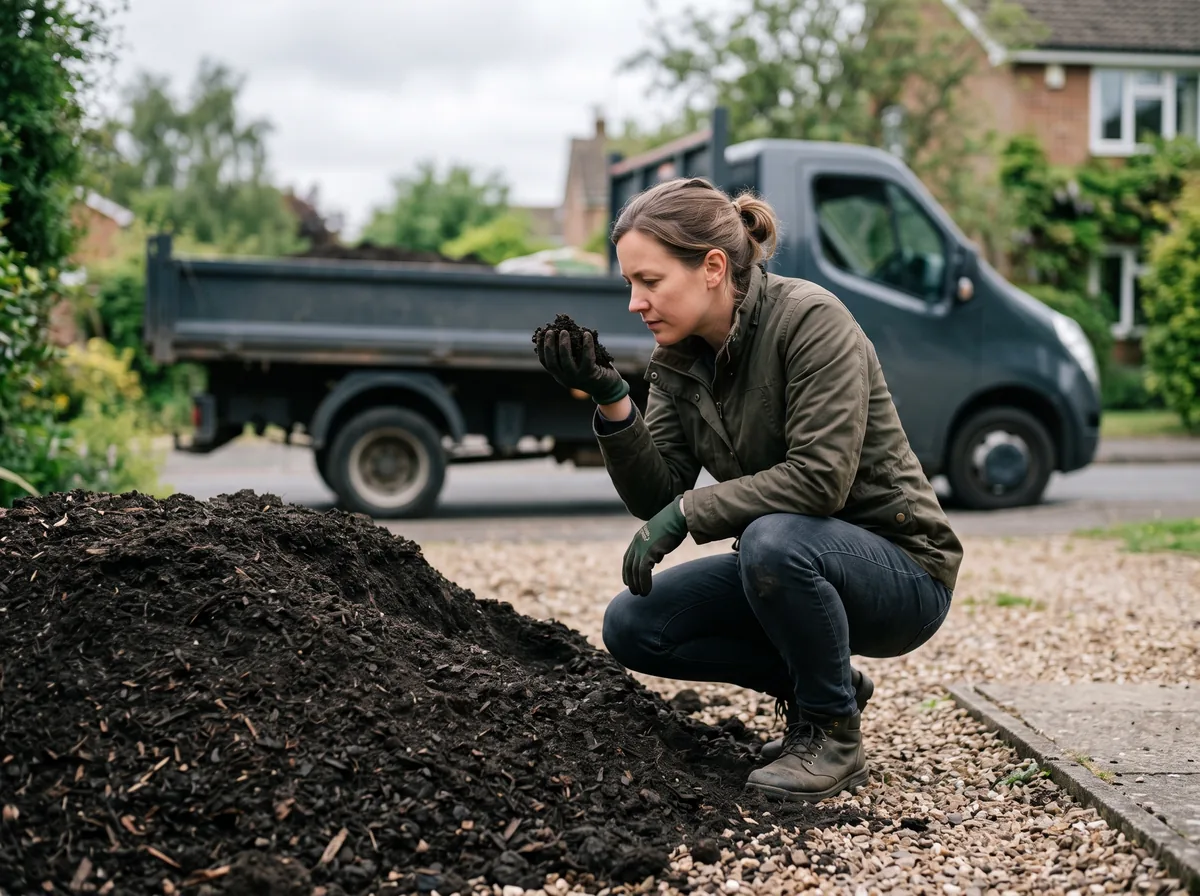
Once topsoil is spread across a yard, it is hard to tell whether it was a good load. On delivery day, before it goes anywhere, it is much easier to check. A few minutes looking at the pile before the crew spreads it can save a callback months later, since a bad load of topsoil for a sod installation is far cheaper to reject on the driveway than to dig up later.
- Uniform, dark colour throughout the pile. Streaks of grey, orange or pale tan mixed in usually mean subsoil or construction fill got blended in somewhere along the way.
- Crumbles easily in your hand rather than forming a hard clod. Soil that stays in a dense, sticky ball when squeezed is generally heavier in clay than a good sod bed should be.
- No large stones, roots, or construction debris. A few small stones are normal. Chunks of concrete, brick, plastic or large roots point to poorly screened material.
- No strong sour or ammonia smell. Fresh topsoil smells earthy, not sharp or chemical. An off smell can mean the pile has been sitting wet and anaerobic for too long.
- Few or no visible weed seed heads or grass clumps. Topsoil pulled from a weedy field can seed your new lawn with exactly the weeds you are trying to avoid.
Red flag
A load that looks fine on top but reveals streaks of orange or grey clay when you dig a shovel a foot into the pile has likely been mixed with excavated subsoil. Always check a few spots through the depth of the pile, not just the surface.
Where this fits with testing and prepping your soil
Topsoil quality is one piece of a sequence, not a standalone decision. Testing the existing soil on your property tells you what you are starting with, which is what decides whether you need a thin top-up, a full replacement layer, or something in between. From there, getting the site itself ready for sod covers clearing, grading and rough levelling before topsoil goes down at all. Run those two steps first and choosing the right topsoil for sod installation becomes a much shorter conversation with your supplier.
Good to know
This guide describes general characteristics of good and poor quality topsoil. It is not a substitute for a soil test or a site visit specific to your property, and exact depth, blend and volume needs vary by yard. Confirm the right specification for your project with your supplier or installer before ordering material.
Get the sequence right in this order and the topsoil stops being an afterthought squeezed in before delivery day, and starts doing the job it is actually there for.
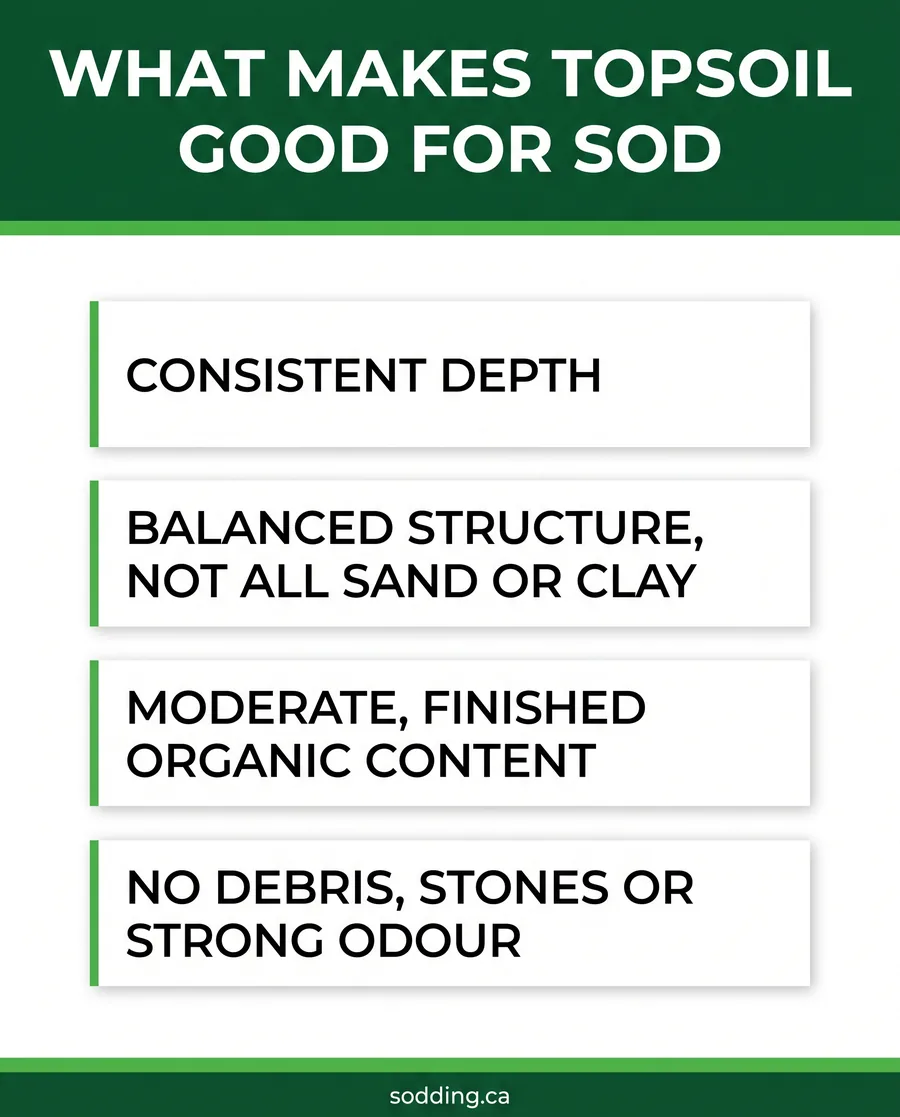
Download the free quick guide
A printable rundown of what to check on delivery day, so you can look over a load before it gets spread.
Frequently asked questions
How much topsoil does a typical sod installation need?
It depends on how much usable topsoil is already on the property and how much grading the site needs, so there is no fixed figure that applies everywhere. A soil test and a site visit are the two things that actually answer this for your yard. Ordering based on a rough online estimate without either one often means paying for material you did not need or coming up short partway through the job.
Can I use bagged garden soil from a hardware store instead of bulk topsoil?
For a small patch repair, bagged soil can work in a pinch. For a full sod installation, bulk topsoil sourced for turf use is generally a better fit, since it is typically screened and blended specifically for that purpose and is far more cost-effective at the volumes a whole yard requires. Ask your supplier what the bagged product is actually formulated for before relying on it for an entire lawn.
Does darker topsoil always mean better quality?
Dark colour is one sign of organic content, but it is not the whole picture. Some naturally dark soils are still heavy in clay or poorly drained, and some lighter coloured blends are well structured and perform fine under turf. Colour is a useful first check on delivery day, alongside texture, smell and the presence of debris, rather than a reliable measure on its own.
What happens if bad topsoil already got spread before I noticed?
It depends on how far along the job is. If the sod has not been delivered yet, the topsoil can usually be reworked, screened again or supplemented before installation continues. If sod is already down, the fix is more involved and may mean lifting affected sections. Either way, raising the concern with your supplier or installer as soon as you notice a problem gives you the most options.
Is it worth paying more for premium topsoil for sod installation?
A well blended, properly screened topsoil generally costs more than generic fill for a reason, since it takes more work to produce consistently. Whether the difference is worth it for your project depends on your existing soil condition and budget. A soil test and an honest conversation with your installer about what your specific yard needs is a more useful starting point than assuming either the cheapest or the most expensive option is automatically right.
Where to go from here
Start with a soil test if you have not already run one, then use what it tells you to decide how much topsoil your yard actually needs and what blend suits your existing ground. Check any delivered load against the signs in this guide before it gets spread.
If you would rather have that whole layer assessed and sourced for you, ground prep is built into every job our crews run. Book a site visit and quote and we will tell you plainly what your yard needs before any topsoil or sod is ordered.