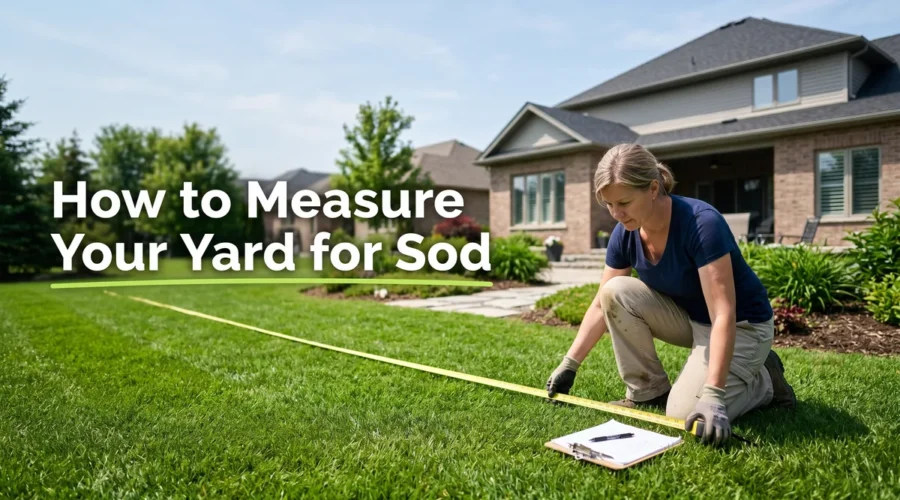
How much sod do I actually need? It is the first question every sodding project runs into, and getting it right saves you from two expensive mistakes: ordering too little and halting halfway, or ordering too much and paying for pallets that wilt in the driveway. Learning how to measure your yard for sod takes about twenty minutes, a tape measure, and a little grade-school geometry. We do this on every job we quote at Sodding Canada, and the method is easy to copy at home.
This is a hands-on, step-by-step guide. By the end you will have a single number, your total square footage plus a small waste allowance, that you can hand to any supplier or installer with confidence.
Why accurate measuring matters
Sod is sold by the square foot, usually in rolls or slabs that cover a set area, and increasingly by the pallet. If your measurement is off, the whole order is off. Come up short and you may not be able to get matching sod from the same harvest, leaving a patchwork lawn. Over-order and you have paid for sod that cannot wait, because fresh sod has to be installed within a day or so of delivery before it starts to break down.
Did you know: Sod cannot wait on the driveway
Freshly cut sod is a living product. Stacked on a pallet in summer heat, it begins to yellow and rot within about 24 hours. That is why measuring accurately matters more for sod than for almost any other landscaping material: there is no leaving the extra in the garage for next weekend. Order the right amount and install it fast.
What you will need
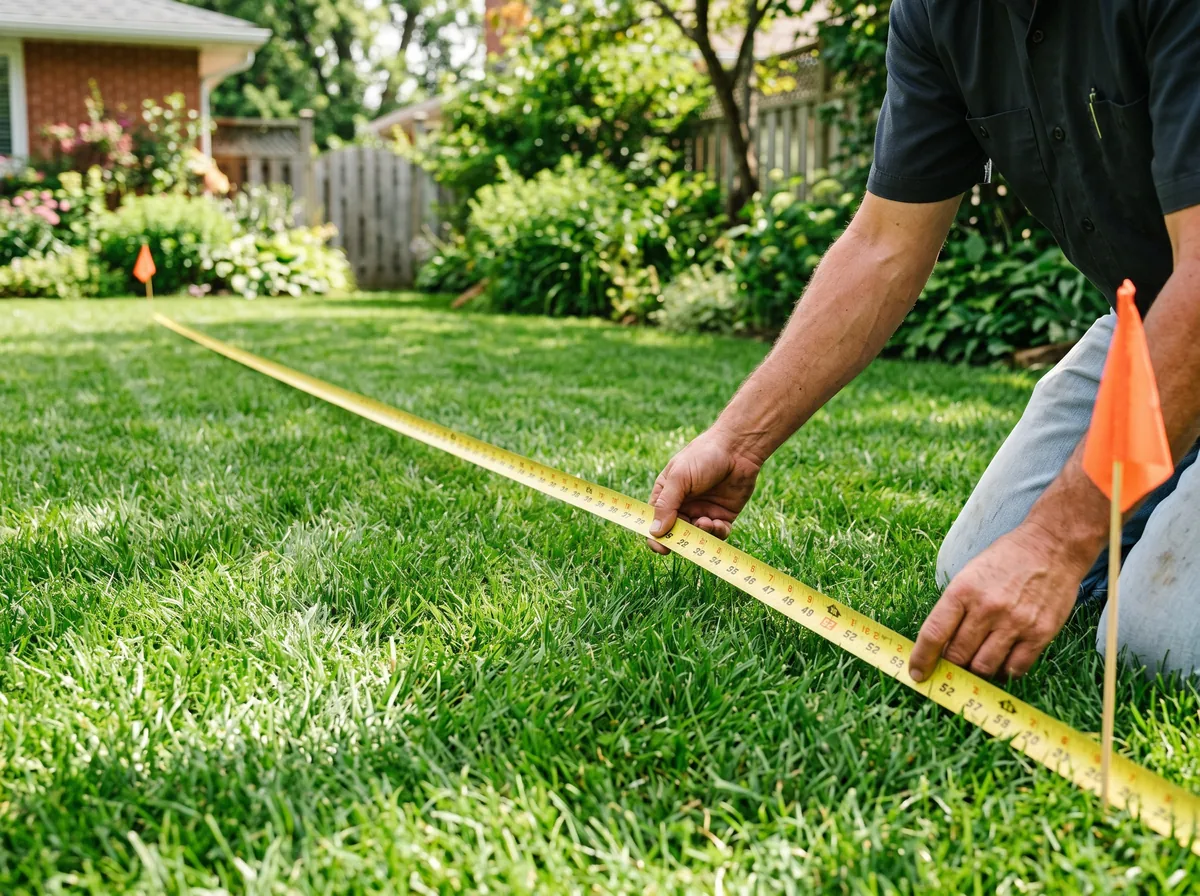
- A long measuring tape (a 100-foot tape or a measuring wheel makes large yards far easier).
- A pen and paper, or a notes app, to sketch the yard and record numbers.
- A calculator (your phone is fine).
- Marking flags, stakes, or even shoes to mark corners on big or irregular areas.
That is it. No special tools. The whole job is measure, sketch, multiply, add up, and round up.
Step 1: Sketch and divide the yard
Please note: The tips here are for general guidance only. Sodding Canada is not responsible for any damage, cost, or loss resulting from action taken based on this content. Every lawn is different; soil, drainage, sun, and existing grass health all change what the right fix is. If a step involves grading, heavy removal, drainage changes, or treating a problem you cannot confidently identify, have your yard assessed in person or call a licensed lawn-care professional first.
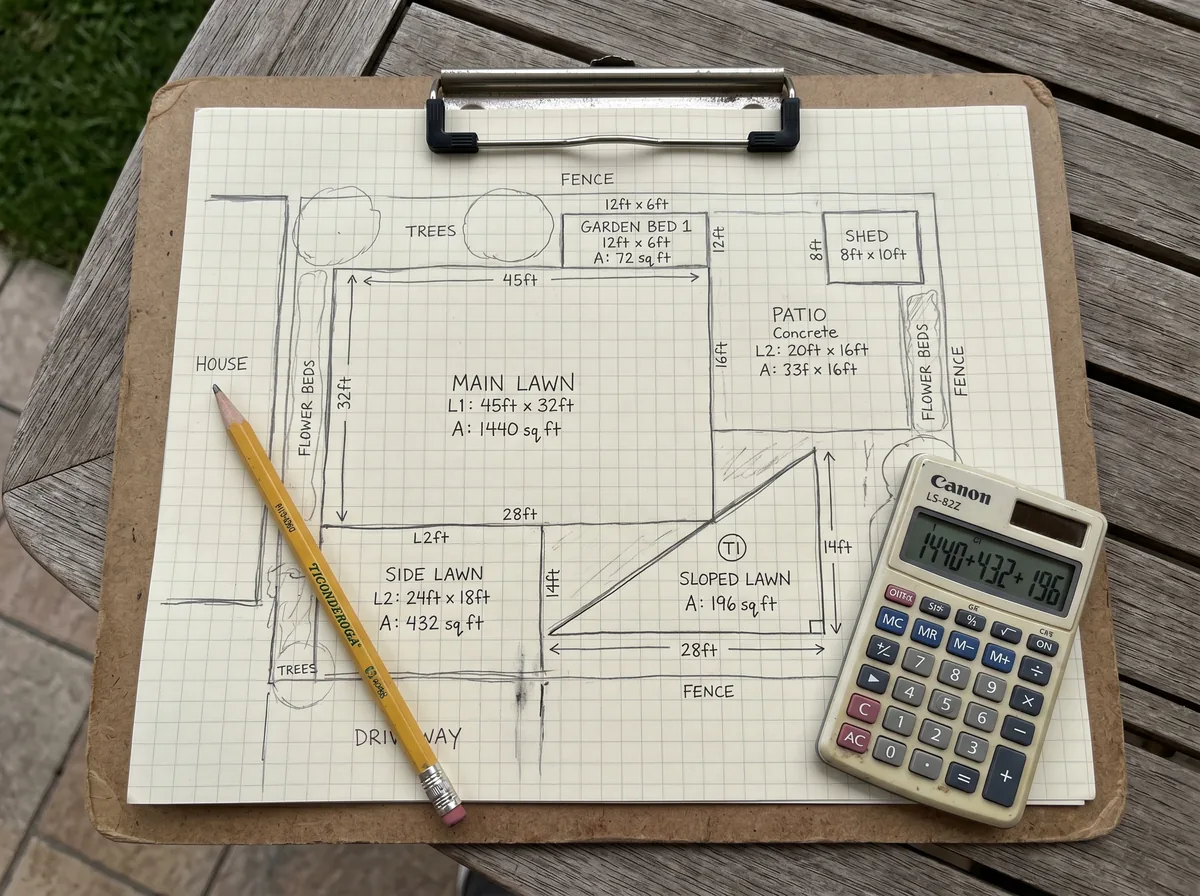
Walk the area to be sodded and draw a rough bird’s-eye sketch of it. Do not worry about being neat. The goal is to break the lawn into simple shapes you can measure: rectangles, squares, triangles, and circles. Almost any yard, no matter how odd, is just a few of these shapes added together.
- Outline the sod area only. Leave out the house, driveway, deck, garden beds, and anything else that will not be sodded.
- Carve it into regular shapes. Draw straight lines across the yard to split it into rectangles and triangles. A curved bed edge can be approximated as a triangle or a half-circle.
- Label each shape. Number them so you can record each measurement against the right piece.
Step 2: Measure each shape
Now measure the real-world dimensions of each shape you drew and write them on your sketch. Keep all your measurements in the same unit, feet are easiest for sod, and measure to the nearest half-foot.
- Rectangles and squares: measure the length and the width.
- Triangles: measure the base (one straight side) and the height (the straight-line distance from that base to the opposite point).
- Circles or rounded areas: measure across the widest point to get the diameter, then halve it for the radius.
Pro tip: Measure twice, mark your yard on each corner
On a big or sloped yard it is easy to lose your line. Drop a marking flag or a stake at each corner before you start so your tape runs straight and you do not double-count or skip a section. For long runs, a rolling measuring wheel is faster and more accurate than fighting a flapping tape across the grass.
Step 3: Do this method for measuring your yard
Calculate the area of each shape, then add them all together. Here are the only three formulas you need, with the square footage you get from each.
| Shape | Formula | Worked example |
|---|---|---|
| Rectangle or square | length x width | 20 ft x 15 ft = 300 sq ft |
| Triangle | (base x height) / 2 | (12 ft x 10 ft) / 2 = 60 sq ft |
| Circle | 3.14 x radius x radius | 3.14 x 5 ft x 5 ft = 78.5 sq ft |
Add the areas of every shape to get your total. Using the examples above, a yard made of those three pieces would be 300 + 60 + 78.5 = 438.5 square feet. Round that up to 439 square feet. That total is the bare minimum of sod your project needs before you account for waste.
Step 4: Add a waste allowance and order
You never order your exact square footage. Every sodding job has waste from trimming pieces to fit curves, edges, and corners, and you want a little spare for any damaged slabs. Add roughly 5 to 10 percent to your total, leaning toward 10 percent for yards with lots of curves, garden beds, or tricky edges.
Save yourself a second trip: The waste math
Take your total square footage and multiply by 1.05 for a simple square yard, or by 1.10 for a curvy or complex one. For our 439 square foot example, that is 439 x 1.10 = about 483 square feet to order. The handful of extra dollars on a small overage is far cheaper than paying a second delivery fee, or ending up with mismatched sod from a different batch, because you cut it too close.
Pricing note: The figures on this page reflect typical market rates in the GTA and York Region as of 2026. What you actually pay depends on your yard size, site access, how much old lawn has to come out, soil and grading work, and the grass variety you choose. Always get a written quote or an in-person assessment before committing to a sod or lawn project.
With your final number in hand, you can price the job accurately. See our 2026 Ontario sodding cost guide to turn square footage into a budget, and if you are still weighing your options, our sod versus seed comparison helps you decide before you order.
Frequently asked questions
How much extra sod should I order for waste?
Plan to add roughly 5 to 10 percent on top of your measured square footage. Use the lower end for a simple, square or rectangular yard with clean edges, and the higher end for a yard with lots of curves, garden beds, trees, or irregular corners, since those create more trimming waste. For example, if your measurements total 439 square feet, multiply by 1.10 to get about 483 square feet for a complex yard. The small cost of a little extra sod is much less than a second delivery fee or the risk of running short and finishing with mismatched sod from a different harvest.
How do I measure an irregularly shaped yard for sod?
Break the irregular area into simple shapes you can measure and calculate. Sketch the yard from above, then draw straight lines to divide it into rectangles, triangles, and the occasional circle or half-circle. Measure each shape, calculate its area using length times width for rectangles, half of base times height for triangles, and pi times radius squared for circles, then add all the areas together. Curved bed edges can be approximated closely enough as triangles or half-circles. This divide-and-add method handles almost any yard shape without complicated math, and it is exactly how the pros estimate odd-shaped lawns.
How many square feet does a roll or pallet of sod cover?
It varies by supplier, so always confirm the coverage before you order. As a general guide, a standard sod roll or slab often covers around 10 square feet, and a full pallet commonly covers somewhere in the range of 400 to 700 square feet depending on how it is cut. Because these figures differ between sod farms, the safest approach is to give your supplier your final square footage, including the waste allowance, and let them tell you how many rolls or pallets that works out to. That way the math matches their exact product and you avoid an awkward shortfall.
Do I need to measure if I am hiring a professional installer?
You do not strictly need to, since a good installer will measure the site themselves as part of preparing an accurate quote. That said, measuring your own yard first is still worth the twenty minutes. It gives you a rough expectation of the project size, helps you sanity-check the quote you receive, and lets you budget before anyone visits. If you measure and the numbers are wildly different from a quote, that is a useful prompt to ask questions. When we quote a job, we confirm the measurements on site, but informed homeowners always make for smoother projects.
Quick recap
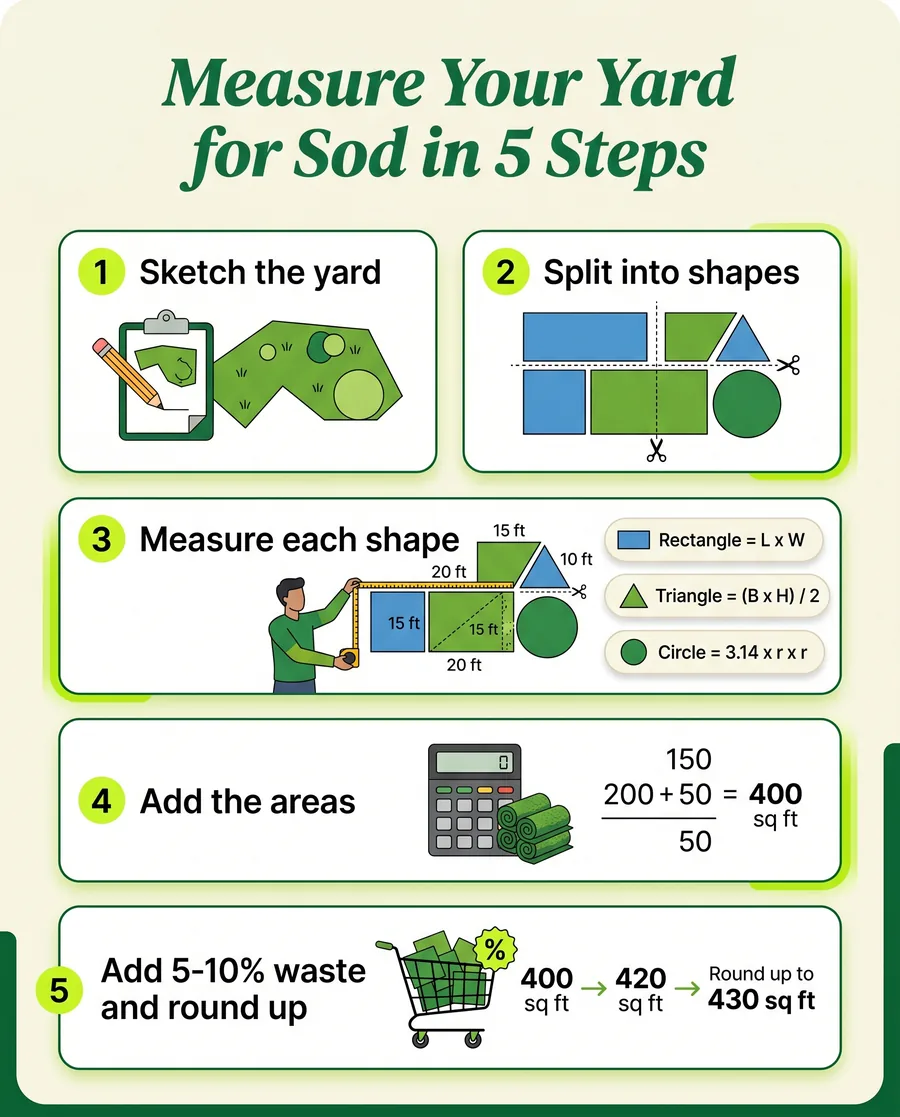
Measuring for sod is just five moves: sketch the yard, split it into simple shapes, measure each one, add the areas, then add a waste allowance and round up.
- Sketch the sod area and divide it into rectangles, triangles, and circles.
- Measure each shape and apply the formula: length x width, half base x height, or pi x radius squared.
- Add every area together, then add 5 to 10 percent for waste and round up before you order.
Once your number is set, you are ready for the next steps: removing the old grass, preparing the soil, and finally installing the sod at the best time of year for Ontario.
Download the free quick guide
A printable worksheet with the shape formulas and a waste-allowance table so you can measure and order in one pass.