
Southern Ontario sees several severe thunderstorm watches every summer, and more than a few of them land in the exact week a homeowner has fresh sod down. If you just booked a new lawn installation and the forecast is suddenly showing a downpour, you do not need to panic, and you do not need to cancel anything. You do need a short plan for heavy rain after new sod, because what you do in the day before and the day after the storm matters more than the rain itself.
This is a timeline, not a list of worries. Work through it in order, from the forecast landing on your phone to the days right after the storm passes.
Why heavy rain after new sod is a real concern
Established grass has a deep, spread-out root system that generally shrugs off a hard rain. New sod does not have that yet. In the first few weeks, its roots are shallow and still working their way into the soil underneath, which makes the whole system more sensitive to two things a heavy storm brings: standing water and force.
A short, intense downpour usually causes less trouble than prolonged rain that keeps water sitting on the surface for hours. The concern is rarely the rain itself. It is water pooling somewhere it should not, or a hard current of runoff moving across ground that has not knit together yet. Handling heavy rain after new sod mostly means managing those two things, not the storm itself.
Before the storm: What to check
If you have a day’s notice, a few checks are worth doing while the ground is still dry. Most of the prep work for heavy rain after new sod happens in this window, before a single drop has fallen.
- Walk the yard and look for obvious low spots. These are where water is most likely to pool during and after the storm.
- Check that downspouts and any drainage routes are clear. A blocked downspout dumping water onto new sod in one concentrated spot creates far more force than the same rain spread evenly.
- Hold off on any planned watering. There is little reason to add water ahead of a forecast that is about to add plenty on its own.
- Skip mowing or any foot traffic you were planning before the rain arrives. Wet, unrooted turf is more easily disturbed than dry turf, so avoid adding pressure on top of the weather.
None of this changes the underlying watering routine described in our general watering guide. It simply pauses the parts of that routine that are about to be handled by the sky instead.
Save yourself the guesswork
You do not need to run outside mid storm to check anything. Wait until the rain has stopped, or at least eased to a light drizzle, before you walk the yard. Checking during a downpour risks compacting wet turf with your own footprints for no real benefit.
During the storm: What to leave alone
There is genuinely very little to do while the rain is actually falling, and that is by design. New sod is meant to handle reasonable rainfall on its own once it is down; the goal during the storm itself is simply to avoid adding stress on top of the weather.
- Stay off the lawn entirely, including pets, until the rain has passed and the surface has had time to firm back up.
- Leave any tarps, stakes or edging in place rather than adjusting them mid storm; movement while the soil is saturated is more likely to shift sod than the rain is on its own.
- If you notice water beginning to run in a visible stream across one section, make a mental note of where, so you can check that spot specifically once it is safe to go outside.
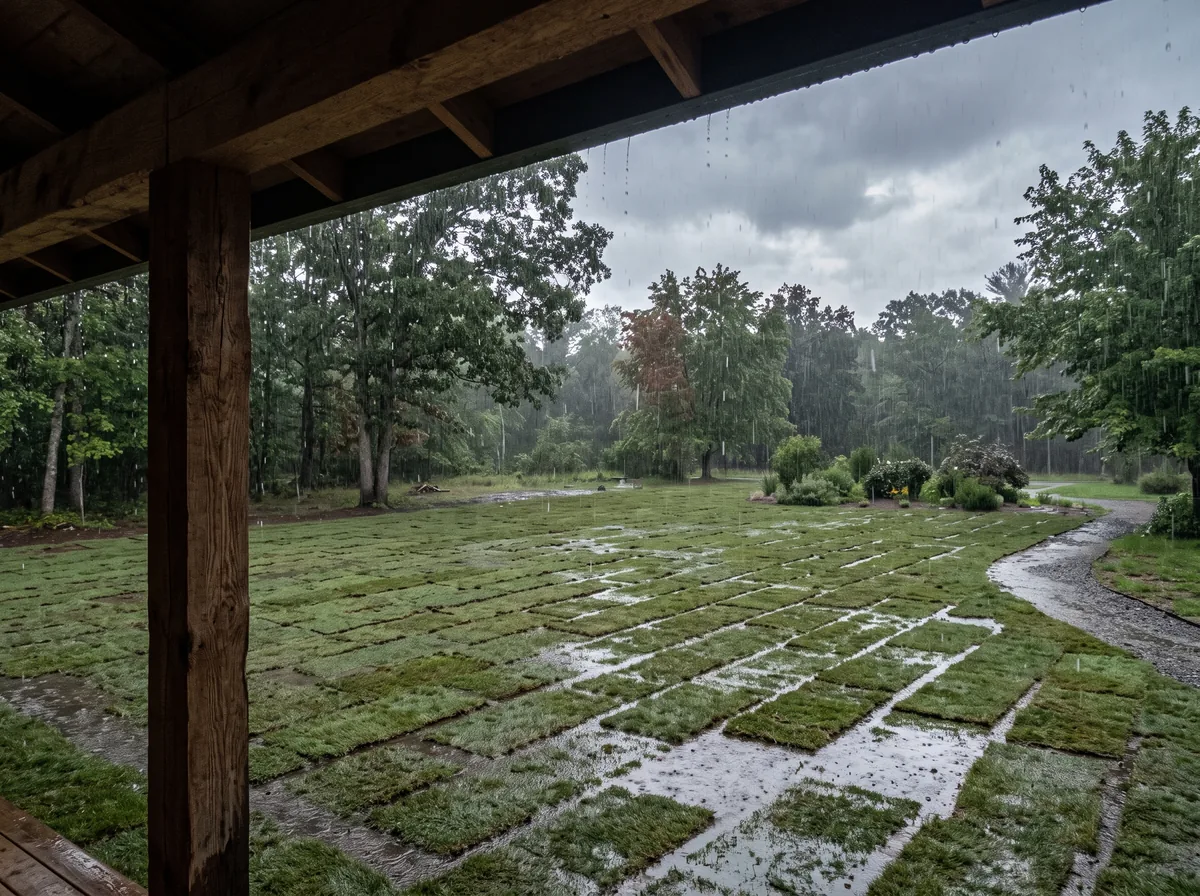
After the storm: What to check first
Once the rain has stopped and the ground has had a little time to settle, usually a few hours rather than immediately, walk the yard and look for three specific things. This walkthrough is the single most useful habit for managing heavy rain after new sod, because it catches small problems while they are still easy to fix.
- Lifted or shifted edges: Look along the seams between rolls of sod. A strong runoff can occasionally lift an edge or push a piece slightly out of place, which is straightforward to press back down and firm up while the soil is still soft.
- Washed out or bare patches: Runoff moving fast across a slope can occasionally wash a thin layer of soil out from under a seam. A light topdressing with matching soil, pressed in firmly, generally corrects this.
- Standing water in low spots: Some pooling right after a heavy storm is normal and usually drains within a day. Water that is still sitting well beyond that is worth watching more closely, covered in the next section.
If your sod arrived within the last week or two, the week-by-week care guide for new sod is a useful reference for what is normal to see at each stage, storm or no storm.
Red flag
Repeated hard runoff crossing the same section of new sod after more than one storm is usually a grading or drainage pattern, not bad luck. Correcting the water’s path is a more durable fix than resetting the same patch of sod after every heavy rain.
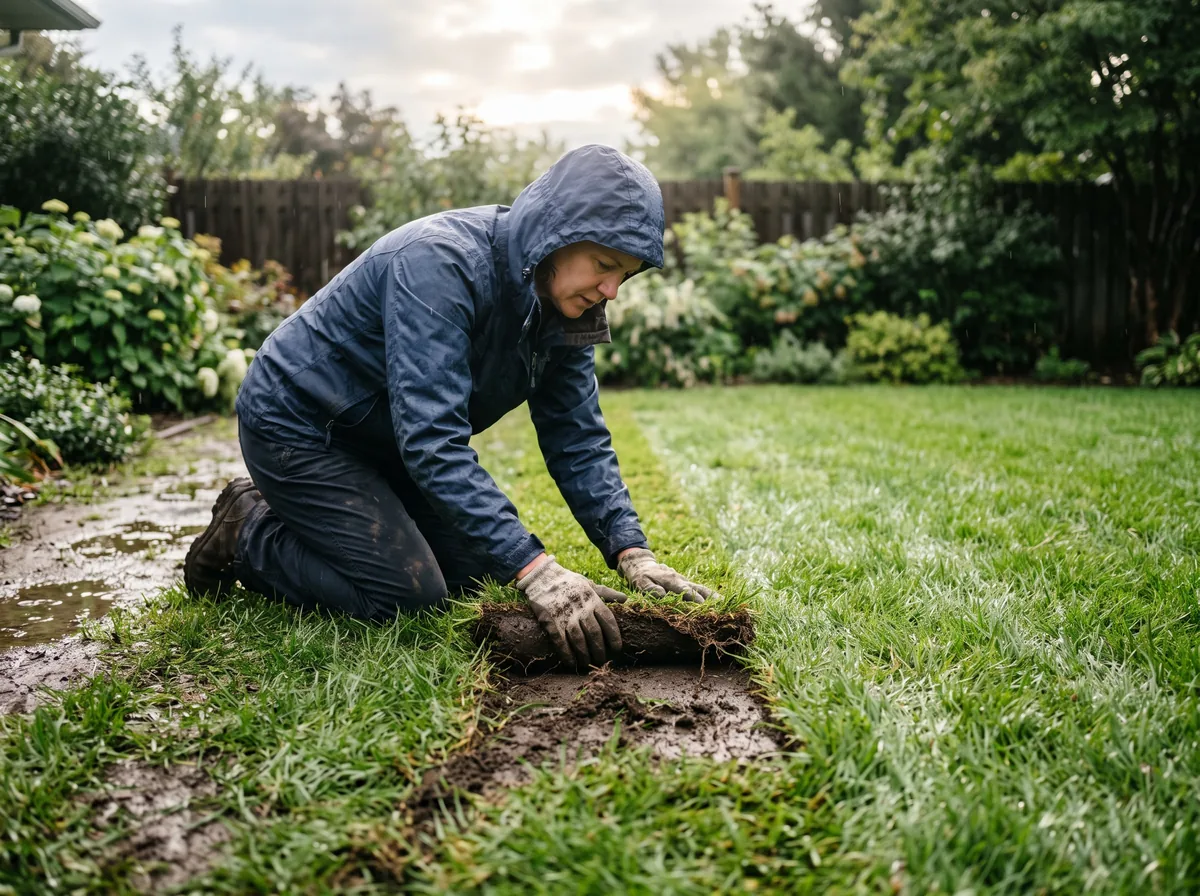
If water is still sitting a day later
Water pooling for a few hours after a heavy storm is ordinary. Water that is still visibly sitting on top of the sod, rather than soaking in, roughly a full day later is a different situation and is worth investigating rather than waiting out. This is the one scenario in this whole guide to heavy rain after new sod that genuinely calls for a second opinion.
This usually points to either compacted soil underneath that point, a low spot that needs regrading, or a drainage path that was already marginal before the sod went in. Grading issues on a sloped or uneven yard often surface for the first time during exactly this kind of weather, since a heavy storm reveals drainage problems a light rain never would.
Good to know
This guide describes general steps for handling a rain event on recently installed sod. It is not a substitute for an on site assessment of your yard’s drainage or grading, and outcomes can vary depending on your soil, slope and the intensity of a given storm. If water is pooling repeatedly in the same area, have the site assessed directly rather than relying on general guidance alone.
For current or upcoming severe weather in your area, the Environment and Climate Change Canada weather alerts page is the primary public source, and it is worth checking before a forecast storm rather than after one has already arrived.
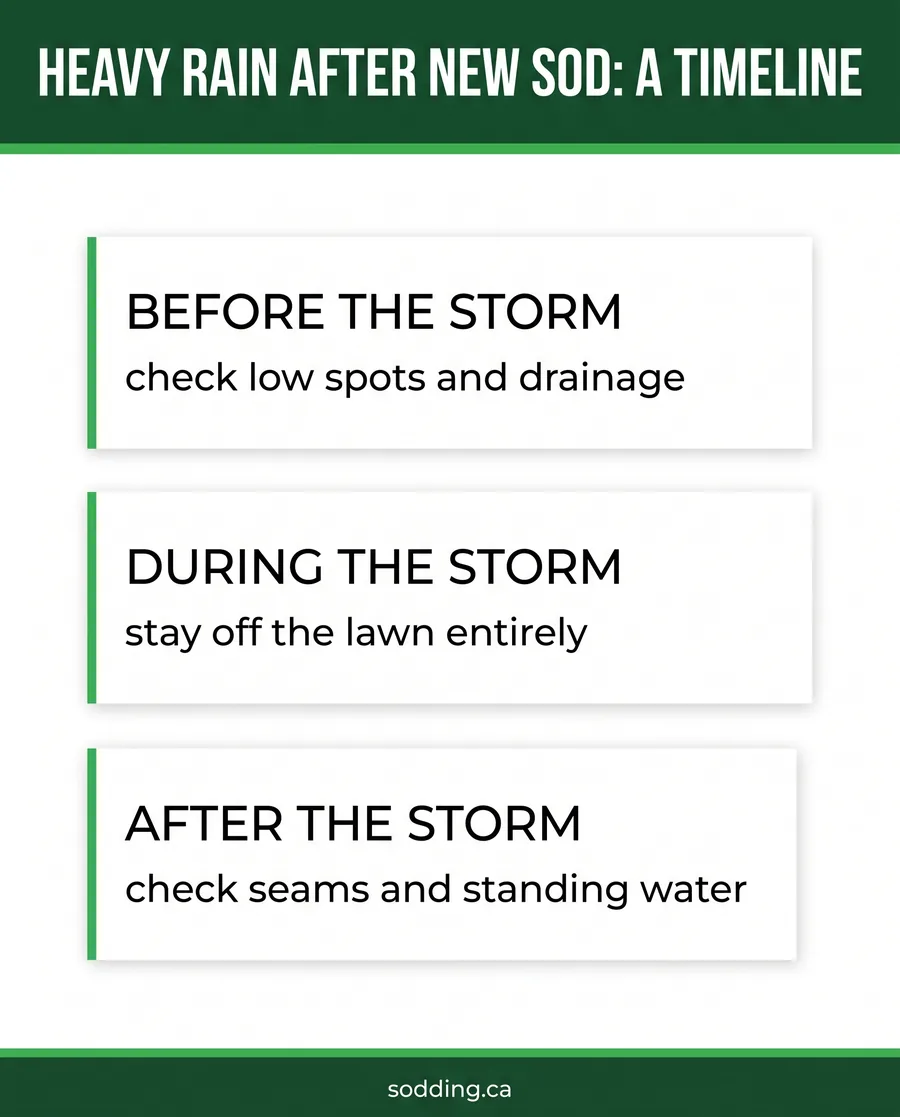
Download the free quick guide
The full before, during and after timeline on one printable sheet, so you know exactly what to check once the storm passes.
Frequently asked questions
Should I cover new sod before a heavy rain?
Generally no. Sod is grown outdoors and is built to handle rainfall; covering it can trap moisture against the surface and create more problems than it solves. The exceptions are unusual situations like an active hailstorm or extremely high winds carrying debris, where the concern is impact damage rather than the rain itself. For an ordinary heavy rain, leaving the sod uncovered and checking it afterward is the more practical approach.
Will heavy rain wash away newly installed sod completely?
It is uncommon for rain alone to wash away properly installed sod on relatively level ground, since the rolls are laid tightly and begin gripping the soil quickly. The more realistic risk is a lifted edge or a washed out patch along a seam, particularly on a slope or near a downspout, rather than losing sod entirely. Checking seams and low spots after the storm catches most issues before they become bigger ones.
Is it normal for new sod to look darker or flattened right after heavy rain?
Yes, this is typically just the weight of the water and the way wet grass blades lie flatter than dry ones. It usually looks normal again within a day as the surface dries and the blades stand back up. If the discolouration persists for several days or is concentrated in one spot rather than the whole lawn, that is worth a closer look rather than assuming it will resolve on its own.
Can I walk on new sod right after a heavy rain to check for damage?
It is best to wait until the surface has firmed up a little rather than walking on saturated turf immediately, since wet, unrooted sod is more easily compacted or shifted underfoot than dry sod. A visual check from the edges of the lawn is usually enough to spot obvious problems like lifted seams or standing water without adding foot traffic while everything is still soaked.
Does heavy rain after installation replace the need for regular watering afterward?
One storm generally does not replace an ongoing watering routine, since new sod needs consistent moisture over its first few weeks, not a single large soak. Once the ground has had a chance to drain and the surface starts to dry, return to the watering schedule you were following before the storm rather than skipping several days on the assumption the rain covered it.
Quick recap
Before the storm, check for low spots and clear drainage, and skip watering and mowing. During the storm, stay off the lawn and leave everything in place. After the storm, check seams, washed out patches and standing water, and watch any spot that still holds water a full day later.
If a storm reveals a drainage pattern that keeps coming back, that is worth a second look from someone who can actually assess the grade. Book a site visit and we will tell you honestly whether it is a one-time fix or a sign the yard needs regrading.